Showing posts with label Bach. Show all posts

Sunday, May 20, 2007

True Beauty

Recordings of Bach's Ich Habe Genug (BWV 82), found their way into my player more often than other works lately. It contains one of the most beautiful arias ever written in history - Schlummert ein. Such exquisite charm. Listening to it never fails to melt me from inside. The recording by Hans Hotter and Peter Kooy are my personal favourites. Simplicity. That's what it needs. Somehow, he just allowed the music to sing by itself without imposing his own vocal and musical authority on the melodic line.


Schlummert ein, ihr matten Augen,
Fallet sanft und selig zu!
The entire aria is summed up in the descending line "Fallet sanft und selig zu". It's just the most natural to allow that line to fade gradually into silence. A small flame flickering and dying out. Just fading into oblivion...


Welt, ich bleibe nicht mehr hier,
Hab ich doch kein Teil an dir,
Das der Seele könnte taugen.
Bach wrote these lines in such a way such that by the time it reaches the end of the respective phrases, one would just be able to sing "taugen" with just a whisper. I've been wondering why some singers would attempt to conserve their breath for the last few words, resulting instead, in the suffocation of the melodic line. In any case, it's just amazing how well this aria was written and phrased. Such sublime beauty. Whenever I listen to this work, it does give me a sense that Bach really have intended the singers to yield themselves to the melodic line and succumb to her beauty.

Beauty. That's what it's about. The beautification of death...

Wednesday, March 21, 2007

A Spiritual Journey With Bach

Ich habe genug,
Ich habe den Heiland, das Hoffen der Frommen,
Auf meine begierigen Arme genommen;
Ich habe genug!

Ich hab ihn erblickt,
Mein Glaube hat Jesum ans Herze gedrückt;
Nun wünsch ich, noch heute mit Freuden
Von hinnen zu scheiden.

I have enough,
I have taken the Savior, the hope of the righteous,
Into my eager arms;
I have enough!

I have beheld Him,
My faith has pressed Jesus to my heart;
now I wish, even today with joy
To depart from here.


The above text is from the first aria from Bach's Cantata BWV 82 - Ich Habe Genug (I Have Enough). I didn't know what made me pick up a recording of this from my shelves last night and play it on my CD player. But I do know that just a mere first few bars into this piece, I felt an overwhelming sense of pathos to this most spiritual work. The first few bars alone gave an unmistakable idea that I was at a start of an intense spiritual journey. In certain sections of this aria, the music reaches a point of anguish and restraint, but not to the extent of losing that innately deep spiritual peace when having our hearts facing towards our Saviour.

How much I love the sound of the oboe d'amore played by Peggy Pearson and how captivating the unique tones of the voice, oboe d'amore, strings and the organ gives the entire work a most sombre quality. The static bass line used by Bach seems to restrain movement of the aria, seemingly to imply that death is eminent. Such a powerful and masterly manner Bach had used this device! I could go on and on about what I felt from just the first aria, but I guess I'll spare everyone of my excessive outpouring of emotions here.

I have to admit that so long after Serene had given this to me as a gift, I have been unable to see anything deep about this work until last night and thus chucked it aside for quite some time until
I felt an invisible urge to play the CD last night. A million thanks to Serene for this gift of a CD by Lorraine Hunt Lieberson. I'm now one of the victims of her amazing artistry. Such a gift of being able to make her music come to life. A quote by Peter Sellars, who did the staging of the two cantatas in the CD featuring BWV 82 and BWV 199.

Her voice is filling the room and you don’t know where it’s coming from… She is going right to the heart of a suffering person, not to increase the suffering, but to heal it, to release it, to offer some kind of balm… which is what her voice ends up doing. It can be piercing and shocking in its intensity, and then this incredible balm of compassion and tenderness, of generosity that is poured out of her voice like a kind of liquid that is there to heal.

Peter Sellars
A little background of this work for some who might be interested, taken from the programme booklet.

The passage of this piece is taken from Luke 2:22-32 and it focuses on Simeon, to whom it has been revealed by the Holy Ghost that "that he should not see death, before he had seen the Lord's Christ." The work is then the contents of Simeon's beatific prayer:-

Luk 2:29 Lord, now lettest thou thy servant depart in peace, according to thy word:
Luk 2:30 For mine eyes have seen thy salvation,
Luk 2:31 Which thou hast prepared before the face of all people;
Luk 2:32 A light to lighten the Gentiles, and the glory of thy people Israel.

Such sincere words fixed to such sublime music. Such beauty.

Friday, March 02, 2007

And Now For The Chaconne

I've been putting it off for too long a time, for fear of desecrating this magnificent masterpiece. Every session of analysing through this work in the past year or so often ended up in a regret that I am not technically proficient yet and also because of the lack a convincing instrument to bring out the beauty of this spiritual masterpiece. Right now, the latter hurdle has been cleared. I'll be be attempting to pick this up in the near future...

I could hear the first 8 bars resound in my head, beckoning me to walk closer...

Irresistible, not because of the fact that it is a monumental work, but because of its wealth of emotional values and lessons I've gained by listening to it and analysing it (though such attempts often left me more perplexed than enlightened, even with something as simple as the re-occurance of the subject itself).

The work itself is a long, arduous journey. Listening to it has been such an insightful, life-changing experience. What about the process of learning, shaping and mastering it? And then how does it feel when I have the piece to come out of me?

Sunday, February 04, 2007

Revelation

I do believe that for most people, at some point of time or another, a random piece of music would start playing in their minds, probably as a subconscious reflection of what they're currently feeling.

I never could quite truly understand the value of the first movement of Bach's Sonata No. 1 in G minor for solo violin, BWV 1001, until tonight as I was walking home. Incidentally, this movement started playing on my mind just as I was on the way back earlier. Of all the music which would most possibly start playing randomly on my mind, this piece would probably rank as one of the least probable ones.

If you had asked me what I thought about this Adagio movement before today, I could never be able to comment more than the fact that it was deeper than what I was able to appreciate of it. A powerful and expressive improvisational touch with an unpredictable yet deeply emotional melodic line. I had naively believed that this movement would have been better composed with a more formal structure in order to retain its emotional value while preparing for the magical Fugue that comes. (Big talk from someone who doesn't have any gift of composition) Just twenty minutes ago, I was made to realise that this movement could never have been better.

In this movement, the unpredictability of the melody really is the eventual creation of one who laments the vulnerability of life to uncontrolled external circumstances. Such rich harmonies, conceived ahead of his time, further intensify the feeling of helplessness. Those numerous trills that scatter themselves all over the movement gives one the feeling of an unnatural suspension in mid-air. Not the sort of certain trills which resemble the sounds of nature, of birds singing. And not to mention that some of their resolutions aren't completely smooth and doesn't make one feel at home. And seemingly, after a most spiritual journey, one finds himself back on the same spot as he has started. Spending our lifetime walking in circles?

Somehow, I have a sudden craving to hear some Erik Satie. An atmosphere of a certain sadness and indifference... ending up in a completely foreign place at the end...

Sunday, October 22, 2006

A Charming Quote

As much as I love Beethoven and Mozart, the greatest is Bach. And they would be the first to agree. For me, to play Bach is a matter of hygiene. It's like taking a shower.

-Andras Schiff

I guess Andras Schiff had said it all. That's probably still an understatement of how powerful and spiritually uplifting playing Bach is...

I have to admit that the quote was stolen from Patricia's blog at oboeinsight. I'll have to apologise to her, but I really can't help but post up such a truthful statement which I completely agree with. =)

Thursday, June 15, 2006

Mass In B Minor

It was an evening of pure ethereal bliss. The Collegium Vocale Gent from Belgium came down to town to perfrom Bach's Mass in B minor. This ensemble founded by Philippe Herreweghe in 1970 is renowned for their interpretation of Baroque music and boasts of over 70 recordings since they were established.

The Mass in B minor was written when Bach was still holding the post of Kapellmeister at St. Thomas in Leipzig. The first question that seems to strike most people upon the realisation of the existance of this work is probably why Bach, a most devout Lutheran, would compose a Mass of such monumental proportion. Of course, the simple explanation that the work was too long to be used for a Catholic service was often put forth to appease the simple-minded that Bach was still the man with a firm protestant faith, but it doesn't quite answer the question about the significance of such this masterpiece. An honest listening to the music actually hinted a deeper and more meaningful significance of this work.

In this work, Bach had used a multitude of styles, from the traditional motets to the contemporary concerto and the different fugal forms, each honed to the highest level in both the ripieno singers and concertino singers movements. The existance of such a colourful myriad of styles hints at a composition to showcase the composer's compositional techniques, rather than one with a more coherent musical content. On top of that, the departure of the standard Latin text and standard structure of certain sections would bar its use from both the Catholic and Protestant masses. Given the importance and significance of the mass in traditional vocal music, it wouldn't be surprising that Bach would actually like to try his hands on this particular 'form' of vocal music which has proven itself to be able to withstand the onslaught of time and changing musical tastes.

Back to the performance last evening. The ensemble was conducted by the founder, Philippe Herreweghe, with Johanette Zomer (Soprano I & II), Damien Guillon (Countertenor), Julius Pfeifer (Tenor) and Thomas E. Bauer (Bass) as the concertino singers. So many aspects to talk about, but I guess I'll start with the conductor and ripieno section, for this work focusses on the choral genre instead of the concertino section, unlike his dramatic Passions and oratorio.

As Philippe Herreweghe walked onto the stage, he looked frail and walked with uneven steps, probably due to hsi old age. Nothing of the power and confidence that exude from the most of the professional orchestral conductors. Let me warn you, looks are deceiving. Beneath that facade is a man of true passion for and knowledge of music. Upon the sounding of the first tutti B min chord, our conductor was brought alive, infused with a musical sensitivity of the highest order. Nothing showy about his actions, but each and every minute action on his part yield a most charming musical effect by his very own ensemble.

Not having the chance to listen to this ensemble before, I was expecting a solemn and rigid playing posture which is characteristic of various professional groups which I had come across in the past few years. I was probably blinded by the fact that they are playing and singing a sacred vocal work. Nothing could be further away from the truth. The ensemble, under the leadership of their conductor, breathed life into this most marvellous work and at the same time, swaying together in the most harmonious and aesthetically pleasing manner. (Not everyone would agree with what they were doing, nor would I agree with every ensemble playing like that all the time, but the way they did it last evening was sure not exaggerated, neither did it affect their playing much from my perspective.) I was pretty amused by this violist who had a pretty awkward right hand position of holding the bow, but apparently enjoying herself as she joins in the music making with the rest of the ensemble. It's sure a most wonderful feeling to be able to make such lovely music with a group of dedicated musicians who feel and think the same way as you do. Alright, guess I should go back to my main topic...

In the ripieno chorus movements of the work, the one which struck me most last evening was no doubt the Cruxifixus. The musicians did justice to Bach's most refined instrumentation in that movement and on top of that, brought out the most potent effect that Bach had created in the concluding section of the movement. As the last two words sepultus est were sung in a cappella style, one could really feel the entire concert hall holding their breath. For that particular moment, time truly stopped and we were all surrounded by the grandest architecture of sounds.

The concertino section were truly charming last evening as well. Well, I didn't quite like the idea of the sole soprano taking on the parts of the two soprano soloists which Bach had intended. As such, the Soprano II role in Christe eleison was taken on by the countertenor. But despite that authenticity flaw, I was still charmed by their duet, with the violin I and II providing the other voice.

I just love the four arias in Gloria. In each, a different principal orchestral instrument is used for the solo, with the solo violin in Laudamus te, solo transverse flute in Domine Deus, the solo oboe d'amore in Qui sedes ad destram Patris, the solo horn in Quoniam tu solus sanctus. Bach gave the four solo instruments, together with the solo singers the most charming and highly individual parts, and blended them together in the most wonderful manner. The last was probably marred by some wrong notes and quite a string of notes with bad intonation, but I guess it's tough for the horn to be just playing one movement for the entire work, coupled with the fact of having to wait quite some time before the movement commences. A horn isn't exactly an easy orchestral instrument to play anyway.

The oboes were especially beautiful, with their most charming tone, coupled with a matured musical sense of the oboists. Oboe d'amore to be more specific. My favourite concertino section would have to be Et in Spiritum Sanctum in the Credo section, with the two oboe d'amore playing the solo instrument parts. They just sound so lovely with the bass last evening. Alright, it's probably a biased comment, for I have always loved the oboe.

As for the Benedictus, they gave the solo instrument part to the transverse flute. The basic practice in their time and all the way up to Beethoven was to attribute the part to the solo violin. In the case of this work, since Bach didn't specify which instrument to take the solo and the tuning fits that of a transverse flute more than that of the violin, I guess that interpretation is justified.

The interpretation of the work on the whole was just the way this masterpiece deserves - refined, charged with life and filled with the most profound spiritual truth. For the whole two hours, I believe that I didn't exist on this earth at all.

It is truly a work which shows forth Bach's invocation and praise for God Almighty. A work, as Christoph Wolff has aptly put it, to unite his creed as a Christian with his creed as a musician in a single statement.

Saturday, April 29, 2006

Simple Pleasures

Isn't it amazing how the oldest music never fail to amaze us with their stunning beauty?

It has been a tramatic week filled with non-musical work and tramatic happenings. I shall do away with the details, but thank God, the week ended peacefully. For the first time in the week, I have the time to sit down and study a score in peace. Since the sheet music for J.S Bach's Flute Sonata BWV 1034 arrived this week, the desire for all things new drove me to make it the subject of my study on this beautiful Saturday.

The numerous themes which Bach had used in the crafting of this 4 movement (slow-fast-slow-fast) work are wonderously pure, weaved into one whole seamless musical fabric with such mastery. After studying the score and being moved by it immensely, it set me thinking. Bach's living conditions were far from comfortable, yet all of his pieces of music are filled with either joy, peace or hope, and every single masterpiece shows his yearning for the ideal state of life, where he could be at peace with the his Almighty Father. It's just how miraculous how every single work can be so mightily charged with a strong spiritual meaning. Our beloved Father has been truly gracious to leave humankind with such stunningly beautiful masterworks through His faithful musical servant. Amen.

5 weekdays facing the ugly sides of human nature before finding peace with God through His Word and music. The peace which eluded me for the past 5 days is sure a welcoming phase in my week. I shall be working doubly hard to infuse a Bach masterpiece into my repertoire.

Monday, January 23, 2006

Bach's Ornamentations

These sure are complicated. Even for a simple appoggiatura written on the score, there's so much to research on - whether the ornament really is an appoggiatura or a nachschlag, whether it should be played on the beat or before the beat, the length the preceeding note ought to be etc. Sometimes, I really wonder how much of this research on ornamentation is justified. As musicians and interpreters of the music, we do have an idea of how the ornament ought to be played, and more often than not, I realise my research on how to interpret those ornaments are simply attempts to search for evidence to support how I feel they ought to be played, instead of digging into those books without any preconceived ideas.

So many complications beneath the simple idea of extemporisation. Maybe we should propose cloning Bach and he might just very well help us answer our doubts...

Tuesday, January 10, 2006

Glenn Gould - A State of Wonder


Indeed, no one can listen to this genius's masterly renditions of Bach's Goldberg Variations and not be completely enamoured by them. Acquired the recording recently and I reckon that it's the definite must-have in every classical music lover's collection. Listening to this particular recording, whether it is his 1955 or 1981 performance, is one spritually rejuvenating journey which I wouldn't get bored taking everyday.

Tuesday, September 13, 2005

Elusive Beauty

That was no doubt the most special moment in my guitar practice for the past few weeks. I have been just focussing on one of the movements in Bach's BWV 1006a, the Gavotte en Rondeau in particuar and it is basically a Rondo with the structure ABACADAEA. Of course, for those who are familiar with the piece will not have any problem with recognising that subsidiary theme E is the climax of the whole movement. But I had a special revelation when I was studying the subsidiary theme D. Bach has wonderfully masked such intense emotions within this playful rondeau. After listening to all of my professional recordings, it was really only those who didn't play in the traditional détaché baroque style that brought the exquisite beauty of the section out. The intense heartaching sensation in the modulation to F# minor in that section really got my adrenalin in my body rushing. From my observation in the facsimile version, if Bach hadn't written extensive slurs in that portion, I suspect even lesser people would have discovered such a heartwrenching beauty. It isn't just playing according to Bach's phrasing but also due to the rich harmonic structure when the basses are deliberately sustained.

Goran Sollscher has managed to capture such this gem in her fullest glory, whereas for the other guitarists, the intensity of this emotion has been reduced significantly due to the lack of sustenance in the basses in that particular segment of the theme. As for the violin recordings, I'm baffled by the absence of the basses in just those few short bars. Yes, the basic mood of the theme was there, but I really thought that it is the basses in the few particular bars of the theme which brings the theme to a climax. Did Bach leave the basses out in the violin version of it due to technical constraints of the violins? Probably so, but I certainly gained so much by studying into the intricate musical details of this movement.

Monday, September 12, 2005

Facsimile Edition

I've been studying the facsimile editions of Bach's Lute Suites and it sure is interesting to learn the now obsolete notations in the Baroque era. Not forgetting the fact that I'm proposing reading such scores as a good method to get a headache. There're lots of ambiguities at first sight and he isn't exactly very tidy. I know Beethovan's worse, but stop bringing him up. The way he wrote his slurs for his instrumental works isn't very clear in the exact notes which are slurred. I just thought this is good as well, at least I can experiment a little on the interpretation of the work and exercise a little discretion on my own in being faithful to the composer. Of course, after all these tedious work, the feeling is just wonderful to be able to bring the whole piece of music alive, especially after adding the tone colour and dynamics to make it sound just the way it ought to be in my opinion.

There're still a whole tonne of information on the interpretation of Bach's music on my table to be studied. Yes, I do get a headache, but there's also this anticipation, thinking of the kind of gems I may be able to extract out of the mine there.

And amidst of these work constantly remind myself that the natural feel of the music must not be lost, which is so common of some of the recordings of Bach out there...

Wednesday, July 20, 2005

Should It Sound Divine or Danceable?

Should my Bach's Fugue from BWV 1000 sound divine or danceable? Have been listening to major artistes from the two general schools playing Bach, with legendary artistes like Henryk Szeryng, Arthur Grumiaux etc in the school which craft Bach's pieces in a divine way and in the other school, there'll be those who play Bach in a lighter, danceable style.

I've never been very supportive of the latter school, especially when they twist and desecrate the works until the very essence of Bach's music is lost. It wasn't until I heard of Hilary Hahn's rendition of Bach that changed my mind. Or rather, she's an exception. She completely tore down the divine nature of the works and recreate a completely different yet amazing effect that is not at all inferior to the former camp. Her recordings of the 3 sonata and partitas captured my total attention the first time I heard them. It's taxing to listen to the Chaconne by Szeryng twice consecutively yet for Hahn, I can just go on and on without feeling any decrease in the intensity and passion. But well, what I could accept from the latter camp can only stop there. I can't accept how artistes like Lara St John and Yo-Yo Ma (his second recording of Bach) butcher up Bach and left his pieces unbearable for the ears.

Of course, now considering the fact that I play the guitar, it'd probably take a miracle on top of an impeccable technique and astounding musicality to make Bach's pieces sound divine. Well, maybe I ought to focus more on making it danceable, yet at the same time not take too much liberty with the tempo...

Tuesday, June 21, 2005

The Bach Concerto You Played That Evening

I'll never forget the image of you playing Bach's Concerto for Two Violins, Strings and Continuo in D minor that evening. That slow, lyrical 2nd movement was like a sharp arrow which pierced straight into my heart, bringing about a wealth of passionate emotions. Despite the annoying murmurings of the unappreciative audience in that casual recital, you have shown yourself to be calm and deeply absorbed in caressing the best tone out of your violin, with no hint of any urgency in your music. Through the heartwrenching and sweet 2nd movement, you seem to be telling me to remember you whenever I hear that piece...

Sunday, June 19, 2005

Beauty of the Fugue

When one mentions the fugue, J.S Bach comes into mind. He's the supreme master of the fugue, a musical form with a texture containing a number of individual voices (a subject and several countersubjects), usually more than two. Fugues usually start with just a short melody, known as the subject, followed by the imitation of several voices in close succession. Yeap, think of that subject jumping, running, skipping and dancing etc. And while the countersubject doing a few stunts here and there, there's the pure subject present at the same time. The greatest monuments of Bach are the Well-Tempered Clavier and Art of the Fugue. So well, that's the fugue in brief.

Just started practising on the Fugue (BWV 1000) by Bach. That's one of the very few fugues I can choose from as the guitar doesn't have the privilege or capability of playing the greatest fugues by Bach. It's still a very lovely piece nonetheless. It's not as easy as it really seems to be. For the first page, most of the fingerings are in the first position, yet it took me hours just to make those notes seem natural at a the slowest speed on the metronome. The fingerings for the left hand aren't hard at all, but trying to control the subject and countersubjects is really challenging. And the very fact that the fingerings on the left hand are easy makes that first page hard to memorise. Problem is that I still can't connect to this piece as well as Prelude, Fugue and Allegro (BWV 998). Due to the time constraints, I guess I'll have to leave the latter to next year. Oh well. But this is the first major piece for the lute by Bach that I'm playing and it's very, very addictive, especially when I think of my guitar being able to sing out this charming piece by my favourite composer at the end of the day. =)

Thursday, June 09, 2005

Unknown Vocal Work by J. S. Bach Discovered


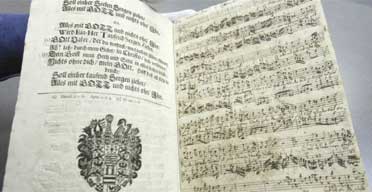
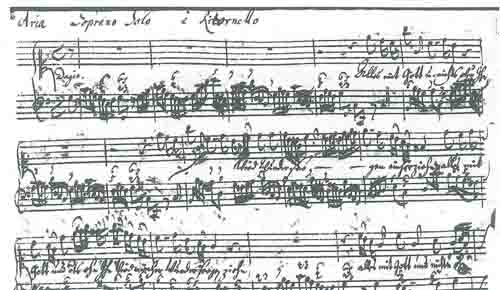
Unknown original handwritten score of our beloved J.S. Bach
Taken from http://www.bach-leipzig.de/

A completely unknown composition by Johann Sebastian Bach was discovered at the Anna Amalia Library in Weimar, Germany by a researcher from the Leipzig Bach Archive. The discovery was made by Michael Maul in the course of a systematic survey of all central German church, communal, and state archival collections, an ongoing research project begun in 2002 and supported by the Packard Humanities Institute and the William H. Scheide Fund.

The score in Bach’s own hand dates from October 1713 and represents a setting of a strophic aria with ritornello for soprano, strings, and basso continuo composed on the occasion of the 52nd birthday of duke Wilhelm Ernst of Saxe-Weimar, whom Bach then served as court organist. The twelve-stanza sacred poem with the text incipit "Alles mit Gott und nichts ohn’ ihn" (Everything with God and nothing without him), the duke’s motto, was written by the theologian Johann Anton Mylius.

There has been no previous record of, or reference to, this composition. Moreover, in the seventy years since the 1935 discovery of the single-movement cantata fragment “Bekennen will ich seinen Namen” (BWV 200) no unknown authentic vocal work by Bach has come to light.

“It is no major composition but an occasional work in the form of an exquisite and highly refined strophic aria, Bach’s only contribution to a musical genre popular in late 17th-century Germany,” said Professor Christoph Wolff of Harvard University, chair of the Board of the Bach Archive, initiator, and supervisor of the current research project. “I am extremly proud of Michael who is a most resourceful researcher,” he added. “In less than three years he uncovered an unparalleled number of new archival Bach documents, but this is the first time he presented a musical discovery. The overall research project is far from being over and I am quite sure that sooner or later Michael Maul will make news again.”

A facsimile and performing edition of the newly discovered piece will be published in the fall of 2005 by Bärenreiter-Verlag of Kassel, Germany. The first recording will be prepared by Sir John Eliot Gardiner, this year’s winner of the Bach Medal of the city of Leipzig.
Woo!! Another work by my favourite composer is found! Praise the Lord! Have been listening to St Matthew Passion by Bach recently. This new vocal work may not be as large scale or major a work as the passion, but I can't wait for the recording to be released!! Sir John plans to record this piece before Christmas and perform it at London's Cadogan Hall on the 18th December 05. The last work by Bach which was discovered was in 1975 - extra canons for the piano in the composer's own handwriting. And as mentioned above, the last vocal work by Bach was discovered in 1935. And now, another work by the legendary composer has surfaced in 2005. To think that it was hidden in a elusive old shoebox for three centuries, concealed with some poems and verses. Apparently, from what Professor Wolff, the world's leading expert on J.S Bach, has mentioned, we don't know much about Bach from this period for very little has survived. Never mind, hope that we shall be able to see more of Bach's works surfacing in the near future. =)