Thursday, September 15, 2005

First Night


It was a night of stylized nostalgia. Guitarist Oscar Herrero was able to bring out the full intensity of the spirit of his compositions in the style of flamenco. Throughout most of the concert, neither did he explain his pieces nor attempt to spice up the mood through words, but his music spoke volumes of the intense melancholic passion he had when composing such pieces. He did speak before his last programme piece, but well, it was in Spanish. Of course, most of the audience probably wouldn't understand, including me, but I somehow made it out that he thanked various people for the chance to perform here. Nonetheless, despite the presence of an audience who didn't understand his language, he indulged himself in the music and didn't show any hint of nervousness.

It did bother me at first when he played into the first few bars of his music. I went into the hall, expecting to immerse myself with the deep Spanish culture and mood, after all, his concert was publicised as a flamenco concert. Yet, what visual images his music brought was not at all Spanish in any nature. It wasn't in any way faithful to the flamenco culture. The excessive rubato which will embarrass romantic performers is totally unacceptable in flamenco culture. What he played was clearly a fusion between flamenco, jazz and classical styles, and I really had a problem identifying what genre of music was I listening to. But to brand himself as a flamenco guitarist is totally ridiculous for the very essence of the flamenco culture is gone. It's pretty near to impossible that a flamenco dancer or singer can accompany a guitarist who takes so much liberty with the rhythm. I was absolutely repulsed by the fact that he actually attempted to sell his hybridized music as flamenco music to people like us, naively believing that we are unaware of the music culture in another place. If he had just termed himself as nuevo flamenco guitarist, I truly wouldn't have minded so much. I could see that my teacher was slightly disappointed, or was he just tired? And it's been such a long time since I've had a lesson with him. As for the guitarist, what a pity, can you hear the Spanish world who is so deeply rooted in the pure flamenco culture lamenting out loud?

What had God done to my day? I didn't even intend to buy the tickets for this concert at all. In the afternoon, I just felt an irresistable urge to make my way down to the concert hall to take a look at the merchandise they had there. Upon reaching there, I was just offered a ticket at a highly subsidiesd rate, which was too good a deal to reject. And at that particular seat, it was just one of the best seats available, with the full dynamic range of the guitar audible to me. He didn't play very loud and I really doubted if those at the back of the concert hall could hear at all. All of his choice of repertoire was directed at stirring up a particular visual picture in my mind. After which, the first bus I took at random went through just that particular route we took that night somewhere around this period last year. I've gotten enough emotions to handle from several happenings these week and now that flood of emotions came. And what intrigues me most is that how the happenings of the day flow so smoothly from one to another just to ignite this particular sentiment...

Tonight, it's going to be Stefano Cardi who'll be playing 20th century guitar music. Now I'm really interested to know how it'll turn out for me. It's nice to know that he has quite a wide range of the type of 20th century guitar music for this performance in Asia tonight - Astor Piazzolla, Mario Castelnuovo-Tedesco, Toru Takemitsu, Heitor Villa Lobos and Manuel Ponce. (The last composer is of course a modern composer who was borned in the wrong era, like Brahms, but well, his music is beautiful in a very traditional tonal way.) And he's also playing pieces by composers which I have not heard of at all - Shih Hui Chen (Chinese guitar composer?), Alber Harris, Ferdinand Morton. Let's just see how the concert tonight turns out...

Wednesday, September 14, 2005

Striking Similarity

Now, after so many entries on Bach, I guess it'll be nice to write a little about modern music for a change. A pretty drastic one, but well, that's what I've listened to recently...

There's this surprising similarity in one of William Duckworth's pieces of music, Dancing the Maze, featured under the Cathedral section (Moments) of the Monroe Street Music website and a track, Land of the Dead, from Philip Glass's CD, Music of The Screens, where he collaborated with Foday Musa Suso. The main theme of Philip's Glass piece has formed the background of William Duckworth's music. The latter's music seems to have a more complex and intricate structure. Does postminimalism simply means the evolution of minimalism into a more sophiscated form? I doubt so, there seems to be something more which I can't find the exact words for. Oh well, slowly, when I'm exposed to more of such music. When listening to such music, I find myself in a world of huge, towering yet obscure structures of sounds which interact with one another in the most mystical and enigmatic manner. Maybe my ears haven't gotten used to just intonation, but at least I can connect so much better with such music instead of feeling strange thinking that they're Indian classical music.

Nuance, nuances and nuances...

Tuesday, September 13, 2005

Elusive Beauty

That was no doubt the most special moment in my guitar practice for the past few weeks. I have been just focussing on one of the movements in Bach's BWV 1006a, the Gavotte en Rondeau in particuar and it is basically a Rondo with the structure ABACADAEA. Of course, for those who are familiar with the piece will not have any problem with recognising that subsidiary theme E is the climax of the whole movement. But I had a special revelation when I was studying the subsidiary theme D. Bach has wonderfully masked such intense emotions within this playful rondeau. After listening to all of my professional recordings, it was really only those who didn't play in the traditional détaché baroque style that brought the exquisite beauty of the section out. The intense heartaching sensation in the modulation to F# minor in that section really got my adrenalin in my body rushing. From my observation in the facsimile version, if Bach hadn't written extensive slurs in that portion, I suspect even lesser people would have discovered such a heartwrenching beauty. It isn't just playing according to Bach's phrasing but also due to the rich harmonic structure when the basses are deliberately sustained.

Goran Sollscher has managed to capture such this gem in her fullest glory, whereas for the other guitarists, the intensity of this emotion has been reduced significantly due to the lack of sustenance in the basses in that particular segment of the theme. As for the violin recordings, I'm baffled by the absence of the basses in just those few short bars. Yes, the basic mood of the theme was there, but I really thought that it is the basses in the few particular bars of the theme which brings the theme to a climax. Did Bach leave the basses out in the violin version of it due to technical constraints of the violins? Probably so, but I certainly gained so much by studying into the intricate musical details of this movement.

Monday, September 12, 2005

Facsimile Edition

I've been studying the facsimile editions of Bach's Lute Suites and it sure is interesting to learn the now obsolete notations in the Baroque era. Not forgetting the fact that I'm proposing reading such scores as a good method to get a headache. There're lots of ambiguities at first sight and he isn't exactly very tidy. I know Beethovan's worse, but stop bringing him up. The way he wrote his slurs for his instrumental works isn't very clear in the exact notes which are slurred. I just thought this is good as well, at least I can experiment a little on the interpretation of the work and exercise a little discretion on my own in being faithful to the composer. Of course, after all these tedious work, the feeling is just wonderful to be able to bring the whole piece of music alive, especially after adding the tone colour and dynamics to make it sound just the way it ought to be in my opinion.

There're still a whole tonne of information on the interpretation of Bach's music on my table to be studied. Yes, I do get a headache, but there's also this anticipation, thinking of the kind of gems I may be able to extract out of the mine there.

And amidst of these work constantly remind myself that the natural feel of the music must not be lost, which is so common of some of the recordings of Bach out there...

About Bach

Bach's music seems so easy to appreciate on the surface, yet everytime I listen to his pieces another time, they never fail to reveal something new to me. Every single piece of Bach's music recorded by decent artists strikes deep into me emotionally and spiritually, especially his vocal music. Yes, the sacred cantatas consists of mostly sermons and teachings of Christ in another language which I don't learn, yet they affect me much like a good sermon does. This really is the magical quality in the music of this legendary composer. I know that I'll never regret my choice of specialising in Bach's music, even though it is the most taxing on my brain cells. There are just so much aspects to take care of to master his music, like his musical shape, phrasing, articulation, ornaments etc. Interpreting his music in the most faithful way is really the hardest as compared to interpreting music by other composers. I've spent weeks going to the arts library to study on every single aspect regarding this composer and his contemporaries for the whole day, yet I felt that it was never sufficient, probably due to the fact that much was lost over the centuries.

Yes, I do know that Bach's music is acceptable when played without much research on him, but such performances lack a certain important quality which brings his music to life. It really is easy to differentiate performers who really study Bach's music intently and faithfully with those who just play as if it's just another musical piece. It is the X factor which brings the music alive, with the audience being able to feel the quintessence of the music, exuding this magnificent godly quality, yet not void of the fragile humane quality so essential in all good music.

An authentic performance doesn't mean playing on period instruments at all. In fact, I've come across certain performances of Bach on modern instruments more honest than those on period instruments. Of course, some superficial effects of modern instruments will overpower the music sometimes, like the volume and quality of the sound, but the faithfulness of the performers to an authentic perfromance does shine through eventually...

There're just so many aspects of Bach's music regarding temperaments, interpretation, instruments, the connection between rhetoric and music, intrinsic value of his music etc to address and I doubt a whole life dedicated to his music will ever be sufficient.
Matthew 5:16 Let your light so shine before men, that they may see your good works, and glorify your Father which is in heaven.
And no doubt, Bach had glorifed God to the best of his abilities.

Saturday, September 03, 2005

Editorial Scores

I realised that editorial publications of sheet music really attempts to shape how the music would sound, not just editorial phrasings but also fingerings as well. Things would probably be alright if I hadn't gotten an idea of how the music ought to sound before I started reading the score. But I really had that perfect music in my mind before I start practising that piece of music, and I find that if the editor has a different concept from me, the technical level would be a few notches higher if I follow the fingerings on it, as compared to when I just play according to how the editor shapes the phrases and devise the fingerings. I have learnt the importance of having the original manuscript of the music beside me. Yes, there may not be as much details as the editorial versions, but at least I know how much of the phrasings and fingerings are the editor's ideas and not the composer and that gives me more space to change fingerings and phrasings to make that piece sound more musical to me.

On the issue of fingerings, modern guitarists have advocated using fingerings that suit you the best, contrary to Segovia's teachings that a guitarist ought to follow the fingerings of the score closely, especially his. In fact, fingerings do play an important part in shaping the piece of music. It's really not about just getting the correct notes out. Sometimes, a phrase has to really convey that sense of huge geographical distance of the notes and it really spoils the phrase when the guitarist takes the easier way out and opt for an easier and less demanding fingering. Therefore, it's not really about using fingerings that suit you the best, but using fingerings that suit the music the best. Segovia was probably right about it, except for that fact that he has this absolute notion that his fingerings were the most musical and therefore the best. However, Segovia's rendition of a lot of pieces doesn't exactly sound musical to me, especially when it comes to baroque pieces. Well, devising good and musical fingerings really isn't easy and takes a lot of effort and knowledge of the music and the instrument, but it's an essential skill that most instrumentalists ought to pick up due to the huge number of scores that have substandard fingerings on them and they're most likely to be regarded as infallible by the inexperienced musicians.

Playing music has been tormenting due to some existing intonation problems, especially when a chord requires some notes on an open string and notes that needs to be held down onto the frets. I decided to forget about keeping those new strings and attempt to fix that intonation problem again. (As you know, when taking out the bridge to make some changes, you need to release the tension on the strings and that'll spoil the strings) Well, it's definitely much better now, maybe because the improvement of my filing technique after a few attempts at fixing that intonation problem on my guitar. At least the filing was much more even throughout the length of the bridge. Now, most of the notes wouldn't be more than 5 cents off their original equal temperament. I was right when it was the problem with the bridge and not with the spacing of the frets. I wouldn't be able to do much anyway if it was really the latter. Thank God, now I'm at least starting to love my guitar a little more...

Saturday, August 27, 2005

Practising Backwards

I never quite believe in practising backwards in order to memorise the piece of music better. It's just detrimental to the musicality of the piece and I find that it's too high a price to pay in order to memorise the piece of music. And I'm really surprised that even professional musicians advocate this method in order to aid memory.

I can never find much sense in practising backwards. You can't grasp the flow of the music. One just start practising the last page or section of the music and more often than not, you start in the middle of a phrase and that is the worst feeling ever. What comes out eventually is nonsensical and meaningless. Even if you separate the piece in a way such that whatever section you play starts on the beginning of a phrase, it is still pretty much as bad because you can't shape the phrase well without knowing the introduction before it and how the phrase fits into the whole picture. Eventually, even if you manage to go through the whole piece, chances are that some sections will stick out like a sore thumb as the piece of music has lost its flow.

Anyways, I lost the connection to quite a number of recordings out there. They don't affect me as much as they used to. Maybe I'm becoming increasingly critical and having higher expectations. Yes, and that also means that I'm getting more nitpicky in the minor details of my music, not to mention that there's still this intonation problem I have. Oh well, practices have become quite a torture. How I wish that I have a better guitar to practise on...

Saturday, August 20, 2005

Crossing Boundaries

The boundaries between classical music (maybe some people might be more comfortable with the term experimental music) and rock music have blurred, especially prominent in the previous few decades. And the thing is that they've both been previously perceived to be on opposite ends of the music spectrum. Maybe that's just part and parcel of this experimental age, where composers have seeked to search for inspirations in their art through other genres of music. Advant-garde composers have sought to study with masters of other genres of music like Indian classical music, gamelan music etc. And whatever modern movement sweeping through the classical scene, we can see it being caught on by the rock scene as well, with microtonality and minimalism as some examples.

I seem to have this feeling that people now are more obsessed with having radical ideas of creating music than in the resulting music that is produced. Heart-stirring melodies and harmonies, though not completely marginalised, have taken a backseat to coming up with the ideas itself. I agree that most of the music they make do satisfy the ear, but they just lack the ability to penetrate deep into the deeper chambers of our bodies...

Now, that's the kind of music that most talented composers of our time are composing. Is it indeed a pitiful wastage of their talent that half of the world is lamenting about, or is it just because the audiences are more narrow-minded than what art audiences ought to be?

Tuesday, August 09, 2005

Carnival of Music #10

Alright, it's my turn to host the Carnival of Music this week. A million thanks to Scott Spiegelberg for hosting a marvellous Carnival last week. Think I'll divide the posts into various genres so readers will find it easier to browse through their beloved topics.

Traditional Classical Music
In the news, we have some problem with iPods playing classical music. I swear this is one of the sickening problems whenever I listen to classical music on the bus and trains, especially symphonies and concertos where there're huge and sudden dynamics changes.
Oh, be sure to take a look at the professional violinist, Midori's blog on her concert tour in Asia. She sure has some interesting insights in this two-week blog.
Also, we have Talvi's experiences with the halls used for the Mostly Mozart Festival.
And not forgetting Greg Sandow's refutation of someone's keyntoe speech about classical music. He even mentioned some excellent ideas on how to attract younger audiences into the classical music scene, though I've some doubts that it'd be productive.

Modernism or Anti-Modernism
This week, Kyle Gann has given some lovely reviews on Aaron Copland's opera The Tender Land and Marc Blitzstein's opera Regina. Alright, the latter wasn't that lovely, from the way he wrote the review, but if his reviews certainly got me interested in getting recordings of such modern opera to listen.
Tim Rutherford-Johnson gave his comments on the a particular music of 1975 - Rzewski: The People United Will Never Be Defeated, in his series of Music since 1960. He sure took lots of effort in looking for 36 links to match the 36 variations in that piece by Rzewski. But I'm sure for lovers of modern music, it'll be worth the time and effort browsing through the list.
Now for anti-modernism, take a look at harpist Helen Radice's opinions on electronic music. Guess she's one of them who's anti-modernism but substantiates her stand very well.

Jazz
Arh, for this genre, Mwanji Ezana has been kind enough to compile a list of links to jazz blogs around the blogosphere. I'm thankful for the help as I know nuts about jazz.

Others
For this section, I'll have posts which consist of a mixture of the previous few genres above. Rob Witt's review of a musicircus book, The Time of Our Singing by Richard Powers, sure got my attention. That's going to one book I'll be looking out for when I visit the library or bookstore.

Would like to thank JohnL for letting me host the Carnival this week and Lynn S for volunteering to host the Carnival next week. Anyone who would like to volunteer to host the Carnival of Music in the next few weeks please feel free to email JohnL at music.carnival@gmail.com. =)

(This is a similar entry of the previous post on the Carnival of Music #10 in order to have the Carnival at the top of my blog for this week.)

Sunday, August 07, 2005

Carnival of Music #10

Alright, it's my turn to host the Carnival of Music this week. A million thanks to Scott Spiegelberg for hosting a marvellous Carnival last week. Think I'll divide the posts into various genres so readers will find it easier to browse through their beloved topics.

Traditional Classical Music
In the news, we have some problem with iPods playing classical music. I swear this is one of the sickening problems whenever I listen to classical music on the bus and trains, especially symphonies and concertos where there're huge and sudden dynamics changes.
Oh, be sure to take a look at the professional violinist, Midori's blog on her concert tour in Asia. She sure has some interesting insights in this two-week blog.
Also, we have Talvi's experiences with the halls used for the Mostly Mozart Festival.
And not forgetting Greg Sandow's refutation of someone's keyntoe speech about classical music. He even mentioned some excellent ideas on how to attract younger audiences into the classical music scene, though I've some doubts that it'd be productive.

Modernism or Anti-Modernism
This week, Kyle Gann has given some lovely reviews on Aaron Copland's opera The Tender Land and Marc Blitzstein's opera Regina. Alright, the latter wasn't that lovely, from the way he wrote the review, but if his reviews certainly got me interested in getting recordings of such modern opera to listen.
Tim Rutherford-Johnson gave his comments on the a particular music of 1975 - Rzewski: The People United Will Never Be Defeated, in his series of Music since 1960. He sure took lots of effort in looking for 36 links to match the 36 variations in that piece by Rzewski. But I'm sure for lovers of modern music, it'll be worth the time and effort browsing through the list.
Now for anti-modernism, take a look at harpist Helen Radice's opinions on electronic music. Guess she's one of them who's anti-modernism but substantiates her stand very well.

Jazz
Arh, for this genre, Mwanji Ezana has been kind enough to compile a list of links to jazz blogs around the blogosphere. I'm thankful for the help as I know nuts about jazz.

Others
For this section, I'll have posts which consist of a mixture of the previous few genres above. Rob Witt's review of a musicircus book, The Time of Our Singing by Richard Powers, sure got my attention. That's going to one book I'll be looking out for when I visit the library or bookstore.

Would like to thank JohnL for letting me host the Carnival this week and Lynn S for volunteering to host the Carnival next week. Anyone who would like to volunteer to host the Carnival of Music in the next few weeks please feel free to email JohnL at music.carnival@gmail.com. =)

Saturday, August 06, 2005

Disgusted

Apparently, someone can't decide whether she wants to be a hooker or a professional violinist. Browsed through her website and there's quite a fair amount of vulgarities and unseemly language. Don't get me wrong, classical music isn't just for the high class people, but the way she portrays herself as a rowdy, punk kid is just so unacceptable of a professional classical violinist. Her CD covers makes me feel as if I'm browsing through some near-pornographic magazine out at the stands. Ok, even if her music is stunningly beautiful (which is far from it, unfortunately), I'll be embarrassed recommending it to friends, for they'll no doubt give me that incredulous look and contemplate whether I'm attracted to the music or CD cover. And I didn't like her interpretations of the tracks in her CDs one bit at all, and you can be sure that it wasn't due to my prejudice against her. I was treating the music as some professional recording, but I was terribly disappointed...

What irks me most is the fact that she has tainted the purity of the classical music scene. I seriously suggest that she should just consider changing profession, for I feel that the red light district suits her much better than a recording studio or concert hall...

Friday, August 05, 2005

Musical Perceptions About the Carnival of Music

Be sure to take a look over at Scott Spiegelberg's blog, where he's hosting the Carnival of Music #9 this week. He sure had an interesting way of putting those musical posts together. That's gonna be the most special Carnival ever hosted ever since it started two months back and more importantly, there're quite a few interesting articles within the jillian number of links this week, so be sure not to miss them out. =)

I'll be hosting the Carnival next week, so if anyone has any posts on music to share, just send them to me at jeff_guitar@hotmail.com.

Wednesday, August 03, 2005

Obsession With Modern Music

I find myself being addicted to books on modern music or composers than classical guitar books. I swear that if I had the money that day, I would have gotten the book on John Cage than the book on the life of Andrés Segovia.

John Cage's repetitive blasphemous comments almost made me tore that pages out. I'm sure if asked on how did he find Bach, Beethovan or Mozart, he'd have condemned them as well. He was one big egocentric person who called people who didn't understand his music idiots and shot down all comments that his music originated from God by repeatedly claiming that he was the sole creator of his music. I'm really interested in his perspective on the world of sounds and admire his innovative composition techniques. He's no doubt a genius, but he's such a 'staunch' atheist. And that pretty much make him a religious fool... Oh well...

Tuesday, August 02, 2005

Schubert's Arpeggione Sonata

Now for something more traditional instead of those tick-tock-bang-boom modern pieces. Have been listening to Franz Schubert's Arpeggione Sonata pretty often these few days. Parts of this profound and emotionally volatile piece sounds terribly anguished and exhibits such cyclothymic qualities while the other parts present the cheerful and lively side of his character, even sounding sugary sweet at times. And the magical side of this piece to me is the transitions between the dark and bright sides never sounded unnatural and it reflects how much emotional turmoil Schubert had gone through in the process of composing this magnificent piece of art.

It was written exactly two years after he contacted syphilis and the following excerpt is part of a letter Schubert had written to his friend Leopold Kupelweiser:

In a word, I feel myself to be the most unhappy and wretched creature in the world. Imagine a man whose health will never be right again, and who in sheer despair over this ever makes things worse and worse, instead of better; imagine a man, I say, whose most brilliant hopes have come to nothing, to whom the joy of love and friendship have nothing to offer but pain, at best, whose enthusiasm (at least of the stimulating kind) for all things beautiful threatens to vanish, and ask yourself, is he not a miserable, unhappy being? — "My peace is gone, my heart is sore, I shall find it never and nevermore." I may well sing every day now, for each night, I go to bed hoping never to wake again, and each morning only tells me of yesterday's grief.
-Franz Schubert, Dokumente 1817-1830, i: Texte, ed. T. G. Waidelich (Tutzing, 1993) 234

And I just know that I'm not going to let this most beautiful gem escape me and I shall master the transcription of piece for guitar and a string ensemble in the near future.

Monday, August 01, 2005

Andrés Segovia - The Primitive Man


Andrés Segovia

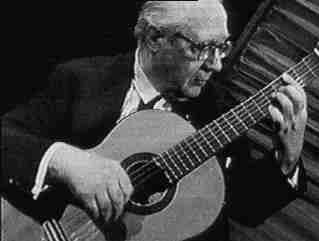
I really wonder how would the present guitar scene be if Andrés Segovia, the father of the modern day guitar, had accepted Arnold Schoenberg's request to write for the guitar. He had previously found the guitar repertoire to be too limited and asked the composers of his day to write for the guitar, yet when Arnold Schoenberg and composers of atonal music came forward to offer to write for the guitar, he had rejected them straight in the face. I do respect him for the fact that he was the founder of the modern day guitar, otherwise the classical guitar will never make it up to the concert stage and John Williams will probably follow his father's footsteps and be a jazz guitarist. But I'm just a little piqued for his action of rejecting compositions by atonal composers and playing most compositions by Manuel Ponce in his later years. Ponce was another composer who was too primitive for his time. I have to admit that he was a prolific composer and I really love his music, but I thought that he would have been more famous if he had been borned a century earlier. Oh well...

Maybe I'm sinking too deeply into modern music. I could feel myself shaking a little when I realised the fact that Schoenberg had requested to write for the guitar and Segovia had slammed the door shut in his face. You could have imagined what nasty things I would have done to Segovia if I was able to go back in time. Atonal music may seem to have less emotional value than traditional tonal music, but I'm liking them for their experimental value. And I just felt it's time we ought to recognise atonal music as a development in the timeline of music instead of pretending that this style of composition had never been present all these while.