Sunday, March 05, 2006

Joining A Guitar Ensemble

In Hector Berlioz and Richard Strauss's Treatise On Instrumentation, Berlioz made the following introduction to the guitar -

The guitar is an instrument suitable for accompanying the voice and for taking part in instrumental compositions of intimate character; it is equally appropriate for solo performance of more or less complicated compositions in several voices, which possess true charm when performed by real virtuosos.

What a wonderfully true comment by the master of orchestration. After analysing the strengths and weaknesses of the instrument, he concluded with the following passage -

Its charm is undeniable, and it is not impossible to write for it so as to make this manifest. The guitar, in contrast to the other instruments, loses when reinforced in number. The sound of twelve guitars playing unisono is almost ridiculous.

Such a judgemental comment from this master is made through astute musical observation and sensitivity. Being a classical guitarist, I shall attempt to elucidate on the implications of such a statement which challenges the presence of such ensembles.

As Berlioz had put it, the guitar is an intimate instrument. In a small cosy setting, it is capable of a myriad of wonderful tone colours, richer than many other solo instruments. However, in a guitar ensemble who'll be playing probably the same repertoire as an orchestra or wind ensemble, the tone colours that all the guitars can come up with is so much more inferior to all the different instruments in an orchestra or wind ensemble.

Moreover, given the technical difficulties of the guitar, it really isn't easy to gain control of the full spectrum of tone colours on the guitar. How then are we confident to gather sufficient guitarists with such technical mastery of the instrument to come together to play? I seriously doubt that it is very possible to attain small scale sensitivity in such a guitar ensemble.

And of course, there's the problem of the narrow range of the guitar. Apparently, in the recent years, people have attempted to stretch the possibilities of the guitar ensemble by the introduction of Niibori guitars such as the Soprano Guitar, Alto Guitar, Prime Guitar Contrabass Guitar and Guitarron. Just today, I was asked to join a newly formed Niibori Guitar Ensemble, playing the arrangement of Isaac Albeniz's Sevilla and Cadiz. I always believed that the guitar works best as a solo instrument but I decided to give the ensemble pieces a try. I chose the Prime Guitar, which the normal guitar at its standard tuning. Well, basically I'm more familiar with it and the Prime plays the solo for the slow section of Sevilla, the portion which is truly captivating.

Well, after the experience, I still prefer playing in a small chamber group with other instruments. Despite my dislike for the guitar ensemble, I shall stick to this Niibori ensemble until it starts to interfere with my musical progress...

Monday, February 27, 2006

Schubert's Arpeggione Sonata


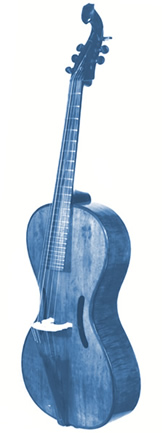
The arpeggione is an instrument which is obsolete nowadays. Pretty interesting instrument which is somewhat like a cross between a cello and guitar. Fretted, the instrument is played with a bow and tuned to the guitar. Back in the early 19th century, Schubert wrote a sonata for the arpeggione and piano, in an attempt to promote this instrument.

Written in November 1824, the Arpeggione Sonata is one of his many late compositions which candidly reflects this Austrian composer's volatile emotional state due to the effects of the syphilitic infection which he had contracted. This composition is such a gem in itself simply because it is the sincere reflection of how this one of the most gifted composer had felt in the last years of his life. This fact alone gives meaning and a deep emotional value to every single note and chord which is written.

This sonata was written two years after the dreaded disease had set in. The music exhibited the same cyclothymic characteristics as the effects felt by Schubert from the onslaught of his venereal disease. The more I listen to this music, the stronger the emotion of melancholy I feel. Somehow, it seems that Schubert, in the midst of his physical and emotional pain (probably from the social stigma associated with syphilis), laments the transience of life and reminisces the good times which he had had.

One feature of this composition which strikes me upon the first hearing were the various almost unexpected changes of mood throughout the music. At the same time, I'm well amazed at how Schubert had the magical musical ability to blend those extreme diverse emotional moods into a seamless music composition of the highest quality.

Though Schubert had immense respect for his contemporary Beethoven, the intensity of those emotions in his music isn't conveyed through to the listeners by intense drama found in Beethoven or Mahler's music, but his own unique poetic style. His lyricism and poetic qualities shines through even in the maddest moments of his music, touching the listeners in the most special way.

And of course, this gem, will soon be in my repertoire. I just can't resist learning this piece of music, no matter how technically challenging it is for my instrument. I'm surprised that they actually have the first movement of this music in the ABRSM Grade 8 syllabus. The almost 10-minute movement can easily be technically and musically more challenging than the rest of the music in there.

Sunday, February 12, 2006

Homenaje Écrite Pour Le Tombeau de Claude Debussy

This piece of music represents one of the first modern compositions written for the guitar by a non-guitarist in the twentieth century - renowned Spanish composer Manuel de Falla. The work revealed his admiration and affection for Claude Debussy with its persistent habanera rhythm as heard in the latter's Puerta del Viño from his Preludes (Book 2) and a quote from La Soirée Dans Grenade to end the piece.

This modern music captured my attention quite some time ago with her ability to evoke the most colourful scenes of Spain, tinted with the pallet of French impressionism. The analysis by Suzanne Demarquez summed this masterpiece up pretty decently:
Falla's piece is a funeral dirge, a symbolic threnody, so frequent in Spanish poetry, influenced by the musical essence and spirit of his departed friend. Its harmony rests on the fundamental fourth of the typical - and so beautiful - chord of the guitar, E-A-D-G-B. Falla places a short rhythmic phrase on this fourth, a kind of muted and bitter lamentation which resounds like a knell throughout the piece. Several echoes of Ibéria (a symphonic poem by Debussy) form the beginning of a theme, a brief motif in triplets marked by the characteristic chromaticism and the augmented second. The special resources of the guitar are skilfully exploited through the arpeggios, very open chords, glissando scales, punteado effects and octave harmonics.
And of course, Demarquez describes this most beautiful ending section which...
sets in bold relief, like a brief ray of moonlight, the clear appareance of a textual citation of the habanera motif, evoking La Soirée Dans Grenade. It is followed by a brief pause. The knell sounds for the last time and gradually fades away in the silence.
How apt has Demarquez put it. Though this piece of music that lasts just slightly over three minutes, listening to it is a heart-stirring experience as the emotional intensity of this music manifests itself by grabbing your full attention.

And of course, this masterpiece will soon be in my repertoire... =)

Monday, January 23, 2006

Bach's Ornamentations

These sure are complicated. Even for a simple appoggiatura written on the score, there's so much to research on - whether the ornament really is an appoggiatura or a nachschlag, whether it should be played on the beat or before the beat, the length the preceeding note ought to be etc. Sometimes, I really wonder how much of this research on ornamentation is justified. As musicians and interpreters of the music, we do have an idea of how the ornament ought to be played, and more often than not, I realise my research on how to interpret those ornaments are simply attempts to search for evidence to support how I feel they ought to be played, instead of digging into those books without any preconceived ideas.

So many complications beneath the simple idea of extemporisation. Maybe we should propose cloning Bach and he might just very well help us answer our doubts...

Tuesday, January 10, 2006

Glenn Gould - A State of Wonder


Indeed, no one can listen to this genius's masterly renditions of Bach's Goldberg Variations and not be completely enamoured by them. Acquired the recording recently and I reckon that it's the definite must-have in every classical music lover's collection. Listening to this particular recording, whether it is his 1955 or 1981 performance, is one spritually rejuvenating journey which I wouldn't get bored taking everyday.

The Truth About The Publications By Andrés Segovia

The guitar repertoire contains quite a number of works which were written for the late Andrés Segovia by various composers. In most of these works with the exception of those by guitar composers, Segovia often took up the job of devising his own fingerings before having the music published. Unfortunately, I've often found that his publishings are most of the time unsatisfactory and more often than not, unreliable. Besides the usual printing errors found in them, Segovia had the bad habit of changing many details in the works which he was dealing with, even to the extent of changing the melodic and harmonic structure of the work.

The most unfortunate fact is that the publications of many works written for him has been founded upon his own texts, and thus, his publication of a particular work is the only version of the work available. Also, the publisher, Schott doesn't seem to be interested in re-publishing the works in a more accurate manner. As such, the process of learning those music often involves a very tedious process of analysing the work to sieve out the more obvious problems and at the same time, sections which are open to interpretation.

In one of such published work of Joaquin Turina I've taken up recently, I've the honour of having the fascimile manuscipt of the work sent to me by the kind Maestro Angelo Gilardino (guitar composer and musicologist). Upon comparison, I realised that there're quite a number of errors whereby sharps and flats are left out and Segovia had actually changed the performance directions which include the dynamics, phrasings and articulation. On top of that, he had actually taken out a bar in the second movement of the work. Sacrilege! And not considering that the fact that the changes he made didn't yield any beautiful musical effects at all...

I'm glad Maestro Angelo Gilardino is currently attempting to rescue all the original manuscripts of those works and publish them. It would be such a consolation for musicians who just have to work with the initial purest state of the work without any filth added in them.

Sunday, January 08, 2006

A Musical Gathering

It's my first musical gathering which I've attended upon invitation. What a lovely environment among people who love music coming together to play lovely chamber and solo music. Isn't it such a beautiful feeling shutting the whole world out and indulging in just making the music amongst ourselves? Besides playing and listening to our music, we share our thoughts and comments on the music as well.

It's been raining the whole day here and I'm truly thankful to spend such a enchanting afternoon in the cosy company of friends who love music. Maybe I should organise another musical gathering and invite friends who share a common passion for music together... =)

Sunday, January 01, 2006

Music To Start Off 2006

I've been cracking my head on how to spend a meaningful new year's eve this year for the past few days. Well, I could join the ranks of people who have nothing better to do and head down to Mount Faber for the biggest local countdown party, or go for my class outing, or join my group of friends who're having a small countdown party. Finally, I've decided to distance myself from the superficial mundanity of the world and focus on the things which are the most dear to me - God and music.

As for the music aspect, I've decided to start on a piece of music which I had always wanted to start but hadn't found time for it. Originally planned to choose some passionate Spanish dance music like the Danza from Manuel de Falla's one-act opera, La Vida Breve, but was browsing through my collection of CDs when I chanced upon the recording of Heitor Villa-Lobos's Bachianas Brasileiras No. 1, 2, 5 & 9, conducted by the composer himself. The elegant and exquisite Aria (Cantilena) from his Bachianas Brasileiras No. 5 caught my full attention and demands that I start on it at that very moment.

Heitor Villa-Lobos is a towering figure in the history of Brazilian music and in this series of music, as the title suggests, fused the soul of Brazil with the spirit of Bach, whom the composer had a deep respect for. This particular fine masterpiece is originally scored for a soprano and eight cellos. The soprano sings a hauntingly beautiful melody of without an identifiable form, remotely resembling the Air in Bach's Third Suite. In the central section, the soprano intones a poem about the charming beauty of twilight, supported by expressive chromatically descending chords. Such immensely expressive music never fails to warm a cold, desensitised heart.

In my sheet music collection, I have two versions of it, one rescored for a soprano and guitar by the composer himself and one rescored for a solo guitar by virtuoso French guitarist Roland Dyens. Shall start on the former as it gives me a better idea of the layers of the music and not to mention the fun of playing chamber music.

English translation of text:
In the evening a rosy cloud, slow and lustrous,
floats across the lovely dreaming sky.
In its infinity the moon gently rises,
glorifying the evening, like a tender girl
who dreamily decks and adorns herself,
longing in her soul to appear beautiful
and crying to heaven and earth, to all Nature!

The birds cease singing their sad laments
and the sea reflects all its riches...
Softly now the moonlight awaits
cruel memories of laughter and tears!
In the evening a rosy cloud, slow and lustrous,
floats across the lovely dreaming sky.

Saturday, December 31, 2005

March No. 1 "Elemental Stage"

Went to the premiere of a composition, March No. 1 "Elemental Stage", by a local composer, Wong Kah Chun yesterday. It was played by the alumni band of the school which I graduated from three years ago. As written in the programme notes, this piece is the first in a series of future compositions whereby the limitations of the march are explored in great detail. In his first march, he toys around with bitonality in various sections of his music.

I would believe the performance last night wasn't quite up to his expectations due to the unbalanced proportion of the sections of the band, not to mention that the musicians themselves aren't seasoned performers.

Nonetheless, it's a pretty interesting work and I'm looking forward to his future marches. His March No. 3, with an enigmatic title, "Project L", will be slated for an informal recording next week. I shall attempt to take time off to attend the session.

Monday, December 26, 2005

Mozart's 250th Anniversary


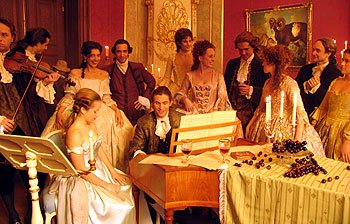
Scene from the new Mozart promotional film (Taken from here.)

The coming year 2006 marks the 250th anniversary of the birth of the most famous Austrian composer of all time - Wolfgang Amadeus Mozart. Plans are in place for a whole string of activities to commemorate his 250th anniversary in Austria next year and there promise to be both pomp and circumstance.

I personally don't quite like the idea of commercialising such a historic event with products bearing the name and pictures of Mozart stacking high along the streets all over Austria. It does seem to me that businessmen are sick of changing the image of their products so often to bear the image of pop stars and decide to turn to someone with a more lasting value.

Despite my discontentment at how some people treat this event, I would still very much love to make my way down to Salzburg to watch the performances devoted to this composer. Well, by the way, Salzburg will host a total of 260 concerts and 55 Masses devoted to Mozart's sacred music, including all his 22 operas performed at the Salzburg Festival next year. A sumptuous feast, isn't it?

Be sure to visit the website dedicated to Wolfgang Amadeus Mozart's 250th birthday - Mozart 2006!

Sunday, December 25, 2005

Christmas


Luke 2:11 For unto you is born this day in the city of David a Savior, which is Christ the Lord.

Christmastime is here again! A day to commemorate the most perfect gift given unto us by God - our beloved Lord Jesus Christ.

This Christmas, my school's choir has been scheduled to carol at Fullerton Hotel for 5 days. Went down to catch one of their sessions and they sang pretty well despite the open acoustics of the hall, not to mention that they are singing more than 10 sessions in total. Besides the joy of meeting friends whom I haven't met for months, the mood that evening was absolutely peaceful and filled with love, away from the overly commercialised environment everywhere else.

It has been such a spiritually and emotionally satisfying Christmas this year, with the close company of God, lots of passionate sacred music, and sensible and matured new friends. =)

Monday, December 19, 2005

Scales Practice

It's been quite some time since I studied and analysed the left and right hand techniques of professional guitarists. Just thought of re-looking at their techniques today, with the hope of incorporating some of their better techniques into my own. As such, I pulled out every single DVD I have of professional guitarists from my collection of music materials to watch.

It came as a revelation to me that most of the differences in their techniques actually stem from their practice of scales. They probably don't practise much scales after turning professional, but I realised that the way their music sounds was still very much dependent on the way they had practised their scales in their youth.

I admit that I haven't been a strong supporter of scales practice before today, despite the fact that my teachers kept emphasising on their importance, which I only discovered today. Even if I were to practise my scales industriously before today, I wouldn't be able to perfect my technique for I didn't know the intricacies of the scale practice that I had to take note of. Comparing the way the different guitarists play, I realise that their overall poise and the amount of control they have over the music actually stems from their movements of the left and right hand movements (all the way from the upper arm to the last joint of their finger).

Most of the DVDs I watched were pretty disappointing. Of course, their music comes across to me as sincere, but I realise that there was 'something' which was holding them back in expressing the full spectrum of emotions in the music they play. And that 'something' was the technique based on the way they practised their scales. Strangely, after that, I just dug out all the scales requirement and started practising on them for hours, and thankfully, I had quite considerable progress.

However, I still wouldn't recommend musicians to whack the scales blindly and merely aiming for speed and 'surface fluency'. I now believe that scales practice is useful only when one has the correct aim of economy of finger and hand movement and at the same time, drawing out the best possible one and volume of the instrument at that particular speed.

Melvyn Tan

The controversy over this Singaporean pianist who evaded National Service has been present for quite some time. Thought of penning my opinions over this issue as a Singaporean musician who is currently serving the much dreaded National Service.

For the benefit of those people who don't know about this issue, here a short biography of him. Melvyn Tan had moved to the Yehudi Menuhin School in Sussex, Britain, to pursue his music studies at 12. However, when he was supposed to return to Singapore at the age of 18 to serve the compulsory National Service, he was accepted in the Royal College of Music in England and decided to go against the law by not returning to serve in the military. Subsequently a year after, he renounced his Singaporean citizenship and since then, he hasn't been back until this year. And basically, he hasn't been setting his foot on his native soil for around 30 years.

When the news of his evasion of National Service first appeared in the headlines, letters of discontentment flooded in the media. When they were published, I was taken aback by the harsh comments that came in. Truthfully, when I first read the news of his evasion, I was surprised I could just shrug it off and chuck it away at the back of my head without feeling much contempt at all, given the fact that my pursuit of my music studies was impeded by these 2 years of National Service. I could roughly guess most of the hateful letters which came in were by those who are currently serving the military, but I never thought they were so unforgiving, to the extent of buying tickets for his concert just to go on strike over there. I just thought that given my circumstances, it was me who should be having such pathetic sentiments.

If they had thought that it was unfair, they can simply go do the same, can't they? It's not too hard to just absent yourself from the military by going overseas to do what you want, is it? Examine their actions a little deeper and it wouldn't take much to understand such feelings just stem from their cowardly nature, which stops them from deserting the military, and jealousy, which is such a perverse emotion found commonly in myopic people who are unable to look at the whole big picture.

As for Melvyn Tan, I admire him for his achievements and for his courage to pursue his own dreams instead of coming back to an organisation where everyone is forced to conform to the system. And no, I don't sympathise with him, instead, I sympathise with those who blasted out at him, for these people haven't been able to look at the whole picture and their opinions have exposed their most pathetic and unforgiving side of human nature.

It's a pity he cancelled his concert and withdrew from judging the National Piano and Violin Competition, for there're true music lovers who would want to attend the concert to enjoy the music. But I guess such actions of his are unavoidable, given the number of immature citizens we have here in Singapore.

Friday, December 16, 2005

Sensitivity

It does seems to me that people who are into serious classical music are more sensitive to their surroundings as compared to people who don't practise the arts at all. For some reason unknown to me, it is those people who practise the arts which are able to detect the first signs of emotional instability in another person. Also, while a musician indulges in the simple and harmonious sounds of nature and cringe at the repulsive, yet almost inaudible noise produced by machinery at a distance away, most people who aren't into music aren't affected emotionally in such a drastic way by such subtle sounds they hear.

It's amazing when I start thinking about how vulnerable I am to the surroundings. It truly makes me feel more human in this modernised society where people just overwhelm themselves with work which numbs the humanistic part of them. It's a truly spiritual experience when I can sit back and indulge in the simple and poetic sounds of nature everytime when people around are procrastinating about their day at work.

On the other hand, I have friends who are so into music at the other end of the spectrum, like trance, which I would classify it as a part of the minimalist movement. Such music (if you would want to call them music in the first place) functions in a totally different way. I haven't gotten down to expose myself to trance music for hours but from their experiences, they said that overlistening just numbs thems and when people ask them what have they been listening to, they couldn't quite answer. It seems to tell me that such music desensitises people instead of heightening their senses like what traditional classical music do. A little of it would help one appreciate the subtleties of sound, but excessive exposure merely desensitises the person I guess.

Wednesday, November 02, 2005

Vienna Boys Choir

The Vienna Boys Choir did a one-night-only concert today in Singapore today. Young boys with sweet and innocent voices. I just checked out some previews of the only CD they brought in today - Vienna Boys Go Pop. Thank God, that they didn't sing any of the pieces they sang in the most repulsive CD they ever made in history!

Let me do a review on the audience tonight for a change. It was full house tonight, not surprising for such a concert, given the amount of publicity they had weeks before. However, it seems to me that the audience in Singapore tonight just can't seem to appreciate the asthetic beauty of music. The repertoire tonight was filled with light-hearted and easy-to-appreciate pieces, with lots of Austrian folksongs and small lieders and hymns by prominent composers. Nothing too heavy. Claps coming in at the wrong time, the level of applause wasn't the least reflective of the level of music they sang etc. Tonight, we have the most unmusical audience who can't even hear the II-V-I perfect cadence ending and applauded without allowing the rest of the audience a chance to savour the precious last few seconds of the music. There's this group of audience who seem to indulge in the fact that an European choir is singing Eastern pieces. Of course, I do recognise the effort they put in but I seriously doubt that their rendition of eastern music in a strange accent with outlandish articulation was well, judging from the response of that group of audience, orgasmic.

But of course, I still enjoyed myself tonight with this simple performance by this lovely choir. =)