It's time to think over the repertoire priorities which I have set in the past two months.
I'll be embarking on solely two gigantic works - Bach's magnificent Chaconne from his Partita no. 2 in D minor BWV 1004 and Schubert's heartwrenching Arpeggione Sonata, for spiritual reasons more than practical reasons. Everything else musical, which includes pieces like the charming Histoire du Tango by Piazzolla, seductive bossa nova pieces and exquisite smaller scale works, shall be shelved temporarily.
More about these two works in the near future...
Tuesday, October 31, 2006

Friday, October 27, 2006
Teaching Music
Is it really that simple when teachers teach their students music? Is it merely about getting the notes out in a beautiful manner?
Now that I attempt to see the whole big picture, it's really about teaching them how to understand themselves through music and more importantly, to respect our fellow human beings as well. It isn't simply about getting the rhythm and notes right but about respecting what the composer had written down. It isn't about showing off your achievement to people who listen to you but to affect them in a spiritual and emotional manner, to touch them in the most special way before they know it, and even to help your listeners search for themselves in this lifetime on earth as well.
Now that I think of teachers, not just of music of course, it really is such a sacred job... If only all teachers in the world could know just how important they truly are...
Now that I attempt to see the whole big picture, it's really about teaching them how to understand themselves through music and more importantly, to respect our fellow human beings as well. It isn't simply about getting the rhythm and notes right but about respecting what the composer had written down. It isn't about showing off your achievement to people who listen to you but to affect them in a spiritual and emotional manner, to touch them in the most special way before they know it, and even to help your listeners search for themselves in this lifetime on earth as well.
Now that I think of teachers, not just of music of course, it really is such a sacred job... If only all teachers in the world could know just how important they truly are...
Monday, October 23, 2006
Preparing A Wedding Programme
Having numerous requests to play for weddings before, I am currently considering to assemble a wedding programme. Think of the money involved. Guess I can't help but be practical. There really isn't any meaningful reason to be engaged to perform in such weddings, but I sure don't like the idea of seeing them walking away with disappointment. Now the question, what would be my programme consist of?
A conversation that occurs so very frequently to me just struck me at this point.
Well, even if I were to assemble a wedding programme, I guess the pieces I mentioned above will be what I'll be playing, together with certain hymnal arrangements. I've gone through the my collection of sheet music containing such music and have certain heart melting pieces in mind. I'm a little stumped at the level of such arrangements as they can easily require a higher, if not the same, technical level than the diploma pieces. Well, I can't really expect lesser if I'm going to choose arrangements by the legendary Roland Dyens, can I? Even hymnal arrangements played by Christopher Parkening can be exceedingly taxing as well.
Well, the good thing is that even if I haven' been approached to play for weddings, I would still like to pick up these pieces...
I'm giving myself a year to assemble an hour of programme of such level...
A conversation that occurs so very frequently to me just struck me at this point.
Friend: Hey, can you play the song Wonderful Tonight? (Or other similarly martian-sounding titles like Penny Lane. I have to admit out of the millions of titles I was requested to play, I could only remember these two.)
Me (Quizzical Look): Huh? What's that?
Friend (Exasperated Expression): Oh my, that's such a common song, for goodness sake!
Me: Common song? (Are they from Mars or something? Suggest some German Lieders back at them? No, they probably don't know them. Let's try some French chansons, any retard will probably be familiar with them.) Well, I know L'Hymne A L'Amour, or Ne Me Quitte Pas, or Revoir Paris or maybe Plasir D'Amour. (They sure look weirder. Ok, let's try something easier.) And I know songs like Fly Me To The Moon and Over The Rainbow.
Friend (Indescribable Expression): Eh, maybe you need to listen to the radio more often.
Me (Raising an eyebrow): Oh, probably so. (Silently thinking: Who's the one who needs to listen to the radio now? I'm not even talking about classical music. Duh...)
Well, even if I were to assemble a wedding programme, I guess the pieces I mentioned above will be what I'll be playing, together with certain hymnal arrangements. I've gone through the my collection of sheet music containing such music and have certain heart melting pieces in mind. I'm a little stumped at the level of such arrangements as they can easily require a higher, if not the same, technical level than the diploma pieces. Well, I can't really expect lesser if I'm going to choose arrangements by the legendary Roland Dyens, can I? Even hymnal arrangements played by Christopher Parkening can be exceedingly taxing as well.
Well, the good thing is that even if I haven' been approached to play for weddings, I would still like to pick up these pieces...
I'm giving myself a year to assemble an hour of programme of such level...
Sunday, October 22, 2006
A Charming Quote
As much as I love Beethoven and Mozart, the greatest is Bach. And they would be the first to agree. For me, to play Bach is a matter of hygiene. It's like taking a shower.
-Andras Schiff
I guess Andras Schiff had said it all. That's probably still an understatement of how powerful and spiritually uplifting playing Bach is...
I have to admit that the quote was stolen from Patricia's blog at oboeinsight. I'll have to apologise to her, but I really can't help but post up such a truthful statement which I completely agree with. =)
-Andras Schiff
I guess Andras Schiff had said it all. That's probably still an understatement of how powerful and spiritually uplifting playing Bach is...
I have to admit that the quote was stolen from Patricia's blog at oboeinsight. I'll have to apologise to her, but I really can't help but post up such a truthful statement which I completely agree with. =)
Thursday, October 19, 2006
Reading Adorno
Thanks to Jeremy Denk's honest entry on Adorno's essays, my interest in that particular book has been piqued. Now that I've acquired this book, I've been spending most of my available time between practices, rehearsals, lessons and performances reading it. (As you can see, the available time that remains is actually the travelling time on buses and trains. How pathetic...) Trust him when Jeremy had indirectly commented that certain sentences of the book are beyond comprehension. It really isn't an easy read.
For the time spent studying Adorno's essays, I could feel all my brain cells to getting to work, making sense of the ideas which were going through Adorno while he was penning down these essays. I guess it's my craving for the most ecstatic state of epiphany upon grasping hold of his intriguing ideas and theories that actually drive me to overtax myself in all the various aspects necessary. I reckon that out of all sentences which I've come across in my life, the single sentence which I spend the longest time pondering on would be from this book. Yes, it is that addictive. His statements have this strange effect of playing on repeat mode in my mind, somehow suggesting that there's a much deeper and profound perspective to them. I often find myself searching my limited musical experiences for cases whereby what I've encountered before can support his ideas and theories on new music. New music. His common citations of works by Schoenberg, Webern, Berg, Wagner and a few other composers have pushed me to explore this personally unfamiliar ground and opened up my mind to the richness and defects in their music, and of course, about the human character as well.
I dare say that my personal fondness in the indulgence of this book has been almost as satisfying as playing music itself. Almost.
A strong recommendation for those who think or are willing to think and want to explore much deeper into the various aspects of music.
For the time spent studying Adorno's essays, I could feel all my brain cells to getting to work, making sense of the ideas which were going through Adorno while he was penning down these essays. I guess it's my craving for the most ecstatic state of epiphany upon grasping hold of his intriguing ideas and theories that actually drive me to overtax myself in all the various aspects necessary. I reckon that out of all sentences which I've come across in my life, the single sentence which I spend the longest time pondering on would be from this book. Yes, it is that addictive. His statements have this strange effect of playing on repeat mode in my mind, somehow suggesting that there's a much deeper and profound perspective to them. I often find myself searching my limited musical experiences for cases whereby what I've encountered before can support his ideas and theories on new music. New music. His common citations of works by Schoenberg, Webern, Berg, Wagner and a few other composers have pushed me to explore this personally unfamiliar ground and opened up my mind to the richness and defects in their music, and of course, about the human character as well.
I dare say that my personal fondness in the indulgence of this book has been almost as satisfying as playing music itself. Almost.
A strong recommendation for those who think or are willing to think and want to explore much deeper into the various aspects of music.
Wednesday, October 04, 2006
Phantom
Just two days ago, a fellow musician explained that she's learning the prelude from Bach's BWV 1006a as that's the favourite piece of classical music of her beloved husband. I was amazed at how much effort she put into the piece of work which was slightly beyond her current technical level. An uncommon stimulus for one to work on a particular work but certainly no less sincere or potent a motivation for them to study the work.
The musical Phantom of the Opera is coming to town again next year. Well, I've never been quite into popular operas, but I do catch them occasionally and appreciate them for their simplistic beauty. This musical, however, holds an important position in my heart, in the same meaningful way how the fellow musician treats her Bach prelude. Despite not being drawn to this production due to the musical qualities, I do find myself having a most urgent need to purchase the tickets as soon as possible for this production which will only be here late March next year...
Apparently, the phantom in me still hasn't faded away over time...
The musical Phantom of the Opera is coming to town again next year. Well, I've never been quite into popular operas, but I do catch them occasionally and appreciate them for their simplistic beauty. This musical, however, holds an important position in my heart, in the same meaningful way how the fellow musician treats her Bach prelude. Despite not being drawn to this production due to the musical qualities, I do find myself having a most urgent need to purchase the tickets as soon as possible for this production which will only be here late March next year...
Apparently, the phantom in me still hasn't faded away over time...
Monday, October 02, 2006
Approaching Music
Wouldn't different people have different interpretations to a particular piece of music, given the almost abstract quality of sounds?
A deceptively simple and innocent question posed to me by a friend who is relatively foreign to the classical music scene.
I guess the presence of an almost infinite possible interpretations within the stylistic guidelines is one most charming and mysterious quality in music. The music exists in a sublime and abstract state until it is subjected to the process of interpretation by a performer or listener, when in that most special moment it crystallises to become something truly personal. I wouldn't deny the fact that the music was created with a main intention of music in mind, and how close others can reach in their interpretations would depend on their level of aural sensitivity and musical knowledge, but to insist that every one, trained or untrained, has to come to that similar interpretation of the composer would make an extreme elitist out of me. I've often restrained myself (unsuccessfully sometimes) in saying statements like "listen the church bells in this part of the music" or "pick out the fighting sounds in the orchestra!", which results in people mentally forming the effects of the music which are mine and matching them to the music. Such statements do make them appreciate the music better in terms of the surface materialisation of the sounds but deprive them of a chance to interpret the music or sounds in their own way through the more intricate music processes.
Approaching classical music is certainly no easy task. Music composed in the different periods are written with particular intentions to people with different expectations and tastes. One certainly can't seek to unify the process of music appreciation for different periods into one which can be readily applied throughout the entire timeline of classical music. Baroque music, created with didactic intentions, often requires a more spiritual and pedantic approach, while romantic music desires a listener willing to be moved emotionally. Baroque, classical and romantic music wouldn't pose much problems for the average listener who expects something meaningful or expressive.
How does one approach avant garde music then? The fact that such music is often unfairly dismissed as musical kitsch only shows how retrograde the listening tastes and approach of consumers of this artistic form are. Such works, created in the light of overwhelming information and knowledge in modern times, contains profound universal truths (in their themes), which wouldn't be uncovered by passive listeners who expects to be moved in the traditional way. The music demands listeners to be actively involved with the musical processes at work by stepping into the abstract world of sounds and rhythms, instead of waiting for something to hit them while they're not prepared to be involved musically. People in the modern society, too often caught up in the wild pursuit of fame and money, turn to music in search of a resting point, expecting a replenishment of the soul before sidelining the arts again for their materialistic pursuit of worldly targets. Avant garde music seeks to rebel against this phenomenom, not by creating random and repulsive noise created in the name of modern art, but by hiding what the human race is looking for in a musical form which is not accessible to those who are unwilling to put in their part to uncover what music has to give. Ingenious. And if one manages to cross this barrier and pick out that gem of truth intentioned by the composer, from personal experience, I can assure that the experience is no less satisfying than listening to a pre-modernism work.
Serious music aside, recently, I've been attracted by the rich culture of Latin America through their music. I have yet to be able to tell apart the more intricate forms of Latin music. Thankfully, a Christian acquaintance and musician in Brazil offered to clarify my doubts about the forms of music they have over there, at the same time mailing over several records of the music at his own expense. It's amazing how rich and powerful the music is. Such music which is created and played at a more common level sure provides a refreshing change from the serious music created for the classical community. Such culturally rich music, like flamenco in Spain, invites the listener into the heartland of the culture and is simply, the voice of the masses and natives. I never fail to be amazed by how easily digestible the music is by people on the opposite end on Earth despite me never stepping into the that continent before.
Maybe such are the music which have a lasting and genuine quality without much drastic changes over the sands of time...
A deceptively simple and innocent question posed to me by a friend who is relatively foreign to the classical music scene.
I guess the presence of an almost infinite possible interpretations within the stylistic guidelines is one most charming and mysterious quality in music. The music exists in a sublime and abstract state until it is subjected to the process of interpretation by a performer or listener, when in that most special moment it crystallises to become something truly personal. I wouldn't deny the fact that the music was created with a main intention of music in mind, and how close others can reach in their interpretations would depend on their level of aural sensitivity and musical knowledge, but to insist that every one, trained or untrained, has to come to that similar interpretation of the composer would make an extreme elitist out of me. I've often restrained myself (unsuccessfully sometimes) in saying statements like "listen the church bells in this part of the music" or "pick out the fighting sounds in the orchestra!", which results in people mentally forming the effects of the music which are mine and matching them to the music. Such statements do make them appreciate the music better in terms of the surface materialisation of the sounds but deprive them of a chance to interpret the music or sounds in their own way through the more intricate music processes.
Approaching classical music is certainly no easy task. Music composed in the different periods are written with particular intentions to people with different expectations and tastes. One certainly can't seek to unify the process of music appreciation for different periods into one which can be readily applied throughout the entire timeline of classical music. Baroque music, created with didactic intentions, often requires a more spiritual and pedantic approach, while romantic music desires a listener willing to be moved emotionally. Baroque, classical and romantic music wouldn't pose much problems for the average listener who expects something meaningful or expressive.
How does one approach avant garde music then? The fact that such music is often unfairly dismissed as musical kitsch only shows how retrograde the listening tastes and approach of consumers of this artistic form are. Such works, created in the light of overwhelming information and knowledge in modern times, contains profound universal truths (in their themes), which wouldn't be uncovered by passive listeners who expects to be moved in the traditional way. The music demands listeners to be actively involved with the musical processes at work by stepping into the abstract world of sounds and rhythms, instead of waiting for something to hit them while they're not prepared to be involved musically. People in the modern society, too often caught up in the wild pursuit of fame and money, turn to music in search of a resting point, expecting a replenishment of the soul before sidelining the arts again for their materialistic pursuit of worldly targets. Avant garde music seeks to rebel against this phenomenom, not by creating random and repulsive noise created in the name of modern art, but by hiding what the human race is looking for in a musical form which is not accessible to those who are unwilling to put in their part to uncover what music has to give. Ingenious. And if one manages to cross this barrier and pick out that gem of truth intentioned by the composer, from personal experience, I can assure that the experience is no less satisfying than listening to a pre-modernism work.
Serious music aside, recently, I've been attracted by the rich culture of Latin America through their music. I have yet to be able to tell apart the more intricate forms of Latin music. Thankfully, a Christian acquaintance and musician in Brazil offered to clarify my doubts about the forms of music they have over there, at the same time mailing over several records of the music at his own expense. It's amazing how rich and powerful the music is. Such music which is created and played at a more common level sure provides a refreshing change from the serious music created for the classical community. Such culturally rich music, like flamenco in Spain, invites the listener into the heartland of the culture and is simply, the voice of the masses and natives. I never fail to be amazed by how easily digestible the music is by people on the opposite end on Earth despite me never stepping into the that continent before.
Maybe such are the music which have a lasting and genuine quality without much drastic changes over the sands of time...
Sunday, August 20, 2006
Cheesecake And Tea
It has been the busiest week ever since the year started, taking on unavoidable, extraneous jobs coming from those incompetent colleagues who lack the adequate skills and intellect to handle, and at the same time balancing my teaching and rehearsal schedules. Somehow, it is at such vulnerable and least rational times when strangely alluring artistic theories decide to introduce themselves and sell their ideas to me. As usual, the hidden adventurous streak in me decided to invite them into my comfortable home and try out their ideas. A costly mistake which almost destroyed the very core foundation of why I practise the arts...
Had a couple of hours to spare between my lessons yesterday, I sought refuge at my favourite tea room in the vicinity. Indulging myself in a pot of Darjeeling tea and a slice of Blueberry cheesecake, I spent the next two hours reading some literary materials recommended by a friend and pondering upon their contents. Staring in my face for the next hour or so was the preface to the novel The Picture Of Dorian Gray by Oscar Wilde. Of course, one shouldn't treat this cynical aesthete so seriously, but it was the very basis of his art that had been eating into my soul for the past week or so.
Being fairly new in the arts and thus restricted my circle to mostly musical techniques at the beginning, I hadn't had the chance and privilege of being exposed to the more modern artistic theories put forth in the arts scene (thankfully!). After deciding to come out of my shell and open myself to the artistic world, I was overwhelmed by the multitude of artistic theories which seem so foreign and appealing at the same time. A part of me just wanted to subscribe to the one which seems to seems most appealing, but thank God, the conservative and rational side managed to suppress the impulsive streak and held out a little longer. What Wilde and many other modernists had believed in, known in French as L'art pour l'art (art for art's sake), certainly has certain most tempting qualities personally. The most transient aural and visual beauty alone truly appealed to my senses and often linger in my thoughts and soul for some time to come, just as the aesthetic visual beauty of the reddish tea in the transparent teacup on the black wooden table is one of the reasons I frequent the tea room I was in. I was on the verge of embracing that theory to be the basis of my music, till Bach chorales and Beethoven symphonies came into my mind...
Somehow, I interpreted the preface as Wilde's personal beliefs and perception of art itself, at the same time justifying each and every statement of it to the content of his works which I spent quite some time on in the past week. He pretty much summed his beliefs in this preface, and ultimately reveals himself in the last statement - All art is quite useless. Of course, on the surface, one can simply conclude that Wilde was trying to be cynical by apparently contradicting the previous statements which he had written earlier. But I would rather interpret that statement as the only and sole meaning in art was its aesthetic beauty, nothing else. Take away the emotions, morality, politics, didacticism in art and what was left (aesthetic beauty) was what he believed to be sufficient to form the basis for pursuing of the arts.
If I were to subscribe to that theory, it would be almost impossible for me to reconcile my art with my relationship with my beloved Father. Holding on a a beauty that is only transient in nature? I'm not quite ready to give up my faith just to pursue the short term preservation of an ephemeral beauty, neither do I think I would be ready anytime in the future. Somehow, such an artistic theory can only be embraced by athetists, or hypocrites...
Such aesthetic beauty, albeit important, wouldn't form the core basis of art itself. Whether which other element ought to be the core element, be it meaning, truth, atmosphere etc., ought to depend on the creator of the works. I wouldn't be in a position to reject any, for my place as a performer and teacher is subservient to the creator, but the least I ought to be doing would be to lay a firm foundation for my music to be performed. Like how Wilde's works reflect his artistic theory, it would be natural that my music would reflect my personal beliefs on art as well...
All this while enjoying the tea with the most sensual and spicy aroma, with the lovely cheesecake to go along with. A pretty charming and slightly mentally chaotic way to spend the evening...
Had a couple of hours to spare between my lessons yesterday, I sought refuge at my favourite tea room in the vicinity. Indulging myself in a pot of Darjeeling tea and a slice of Blueberry cheesecake, I spent the next two hours reading some literary materials recommended by a friend and pondering upon their contents. Staring in my face for the next hour or so was the preface to the novel The Picture Of Dorian Gray by Oscar Wilde. Of course, one shouldn't treat this cynical aesthete so seriously, but it was the very basis of his art that had been eating into my soul for the past week or so.
Being fairly new in the arts and thus restricted my circle to mostly musical techniques at the beginning, I hadn't had the chance and privilege of being exposed to the more modern artistic theories put forth in the arts scene (thankfully!). After deciding to come out of my shell and open myself to the artistic world, I was overwhelmed by the multitude of artistic theories which seem so foreign and appealing at the same time. A part of me just wanted to subscribe to the one which seems to seems most appealing, but thank God, the conservative and rational side managed to suppress the impulsive streak and held out a little longer. What Wilde and many other modernists had believed in, known in French as L'art pour l'art (art for art's sake), certainly has certain most tempting qualities personally. The most transient aural and visual beauty alone truly appealed to my senses and often linger in my thoughts and soul for some time to come, just as the aesthetic visual beauty of the reddish tea in the transparent teacup on the black wooden table is one of the reasons I frequent the tea room I was in. I was on the verge of embracing that theory to be the basis of my music, till Bach chorales and Beethoven symphonies came into my mind...
Somehow, I interpreted the preface as Wilde's personal beliefs and perception of art itself, at the same time justifying each and every statement of it to the content of his works which I spent quite some time on in the past week. He pretty much summed his beliefs in this preface, and ultimately reveals himself in the last statement - All art is quite useless. Of course, on the surface, one can simply conclude that Wilde was trying to be cynical by apparently contradicting the previous statements which he had written earlier. But I would rather interpret that statement as the only and sole meaning in art was its aesthetic beauty, nothing else. Take away the emotions, morality, politics, didacticism in art and what was left (aesthetic beauty) was what he believed to be sufficient to form the basis for pursuing of the arts.
If I were to subscribe to that theory, it would be almost impossible for me to reconcile my art with my relationship with my beloved Father. Holding on a a beauty that is only transient in nature? I'm not quite ready to give up my faith just to pursue the short term preservation of an ephemeral beauty, neither do I think I would be ready anytime in the future. Somehow, such an artistic theory can only be embraced by athetists, or hypocrites...
Such aesthetic beauty, albeit important, wouldn't form the core basis of art itself. Whether which other element ought to be the core element, be it meaning, truth, atmosphere etc., ought to depend on the creator of the works. I wouldn't be in a position to reject any, for my place as a performer and teacher is subservient to the creator, but the least I ought to be doing would be to lay a firm foundation for my music to be performed. Like how Wilde's works reflect his artistic theory, it would be natural that my music would reflect my personal beliefs on art as well...
All this while enjoying the tea with the most sensual and spicy aroma, with the lovely cheesecake to go along with. A pretty charming and slightly mentally chaotic way to spend the evening...
Wednesday, August 09, 2006
Limerence
I have always been trying to put that particular emotion which is so characteristic of some of the Latin American music. A pretty new word for an emotion which is probably older than sin itself.
Limerence. How ironic, such delicate yet powerful emotion, almost bordering on the state of obsession. Check the more scientific meaning by wiki-ing it.
Here're some statements in the article which describes the word.
Now, that's a new word learnt and some food for thought...
Limerence. How ironic, such delicate yet powerful emotion, almost bordering on the state of obsession. Check the more scientific meaning by wiki-ing it.
Here're some statements in the article which describes the word.
Limerence has certain basic components:
-intrusive thinking about the limerent object
-acute longing for reciprocation
-some fleeting and transient relief from unrequited limerence
-through vivid imagining of action by the limerent object that means reciprocation
-fear of rejection and unsettling shyness in the limerent object's presence
intensification through adversity
-acute sensitivity to any act, thought, or condition that can be interpreted favorably, and an extraordinary ability to devise or invent "reasonable" explanations for why neutral actions are a sign of hidden passion in the limerent object
-an aching in the chest when uncertainty is strong
-buoyancy (a feeling of walking on air) when reciprocation seems evident
-a general intensity of feeling that leaves other concerns in the background
-a remarkable ability to emphasize what is truly admirable in the limerent object and to avoid dwelling on the negative or render it into another positive attribute.
Now, that's a new word learnt and some food for thought...
Indulgence
Came home on Monday evening at 8pm to an empty home, feeling blue from the day's mundane work, or rather half a day of mundane work, since I stole the earlier half of the day off to escape from some unnecessary attention at some corner of the city. Decided to take advantage of the rare moment of tranquility in my home to get rid of the blues. Dimmed the lights, played some Piazzollan music by the master himself from my collection, and sat down waiting for the rejuvenating spiritual and emotional bath. It sure came, when the suite - Las Cuatro Estaciones Porteñas, was played. I sure got an overdose of the therapeutic listening when the particular movement Otoño Porteño came on and threw me without the slightest warning into a introspective state. Ended up going for a late night swim to clear my mind and heart of excessive and mindless emotional turmoil. Beneath the almost dark pool environment, save for a few pool lights and dimmed lamps, I swam a few laps at the most relaxed pace, after which I sat by the pool to indulge once again in the mental replaying of Otoño Porteño I heard ealier.
Opening with a most charming theme which would repeat itself in various sections throughout the work, the music paints a dreamy, fluid-like picture. She switches to and fro her angsty moments in a miraculously coherent style so characteristic of our beloved Piazzolla, before closing with a series of extremely heart-stirring and innocent arpeggios played with a alluringly floating touch. The musicians are certainly blessed with the spirit of the Argentinian tango in them.
For just that special moment of musical benediction, I saw myself in an intimately slow tango with a svelte lady in a dance bar in the culturally rich capital Buenos Aires. Somewhere at some obscure part of my mind which still remains rational, I'm thinking of how Piazzolla, who had come out of his ten-year dilemma of whether to be a classical composer or tango composer, with his powerfully evocative masterpieces had singlehanded started the nuevo tango movement. One can't help but acknowledge his talent in this area.
For the next few months, it'll just be incorporating this work of his, in its full soul and spirit into my repertoire. Now, that probably means a whole lot more study and research into the tango style. If there's one place I want to be for the next few months, it would certainly be in Buenos Aires to take in the rich culture of the Argentinians into my subconsciousness.
Opening with a most charming theme which would repeat itself in various sections throughout the work, the music paints a dreamy, fluid-like picture. She switches to and fro her angsty moments in a miraculously coherent style so characteristic of our beloved Piazzolla, before closing with a series of extremely heart-stirring and innocent arpeggios played with a alluringly floating touch. The musicians are certainly blessed with the spirit of the Argentinian tango in them.
For just that special moment of musical benediction, I saw myself in an intimately slow tango with a svelte lady in a dance bar in the culturally rich capital Buenos Aires. Somewhere at some obscure part of my mind which still remains rational, I'm thinking of how Piazzolla, who had come out of his ten-year dilemma of whether to be a classical composer or tango composer, with his powerfully evocative masterpieces had singlehanded started the nuevo tango movement. One can't help but acknowledge his talent in this area.
For the next few months, it'll just be incorporating this work of his, in its full soul and spirit into my repertoire. Now, that probably means a whole lot more study and research into the tango style. If there's one place I want to be for the next few months, it would certainly be in Buenos Aires to take in the rich culture of the Argentinians into my subconsciousness.
Tuesday, August 01, 2006
Frustration
I sincerely believe that we need a publisher which focuses on coming out with urtext versions of guitar compositions. Just to make right the atrocities and abominable sins which Segovia himself had committed. It never fails to drive me mad when I find myself staring at his inferior arrangements and knowing at the same time that his version is the only available publication of that particular work in the market right now.
The last time I was working on Segovia's version of a work by Turina, it sure took me some effort to hunt down a copy of the original manuscript, and realise that the harmonic texture, melodic line and even dynamics have been altered by Segovia. Sheer desecration...
Anyway, besides venting my most childish frustration in this post, I would like to express my most sincere gratitude to Italian composer Angelo Gildardino for providing me the copy of the original manuscript of the work as well...
The last time I was working on Segovia's version of a work by Turina, it sure took me some effort to hunt down a copy of the original manuscript, and realise that the harmonic texture, melodic line and even dynamics have been altered by Segovia. Sheer desecration...
Anyway, besides venting my most childish frustration in this post, I would like to express my most sincere gratitude to Italian composer Angelo Gildardino for providing me the copy of the original manuscript of the work as well...
Sunday, July 30, 2006
Superficial Intentions
What do you feel when you realise that your government opens up a music conservatoire, offers scholarships to overseas talents to come over and study for free with allowance, and it ends up that the conservatoire is made up of all overseas students and the government proclaiming to the whole world that the country has a most vibrant arts scene to nurture artistic talents?
Apparently, they just don't see how their citizens being involved in the arts can help contribute to the economy. So unbelievably practical and myopic.
Such revelations certainly never fail to spoil my day...
Nonetheless, thank God for letting me chance upon this young lady with the sweetest smile in the evening during dinner with my teacher and friends. Now, that certainly lifted my mood and cleared my mind.
Now I think about it, there's not much point fighting the flawed system, is there?
Apparently, they just don't see how their citizens being involved in the arts can help contribute to the economy. So unbelievably practical and myopic.
Such revelations certainly never fail to spoil my day...
Nonetheless, thank God for letting me chance upon this young lady with the sweetest smile in the evening during dinner with my teacher and friends. Now, that certainly lifted my mood and cleared my mind.
Now I think about it, there's not much point fighting the flawed system, is there?
Thursday, July 20, 2006
Check This Out
Chanced upon this simple and interesting site which gives a brief introduction about most of the instruments around.
Here're some statements about the guitar which caught my attention.
Makes me recall the number of times I tried to find tactful ways of changing discussions with my students whenever they start talking about pop or folk music. (Don't you see the big grin on my face?)
You can trust the writer's judgement on that. Of course, I can't exactly compare it to other instruments for I haven't taken up a second instrument, yet.
Not quite a true statement. I would rather indulge myself in some chamber music than solo music. Anyway, I've realised that classical guitarists who prefer solo playing are often lacking in ability to listen and co-ordinate with other musicians. Or maybe the other way around, they probably don't like playing with other musicians for they can't co-ordinate and listen well.
That's pretty much about it. Not much, but do take some effort to visit this pretty decent site.
Here're some statements about the guitar which caught my attention.
Teachers do like to teach the thing they do best themselves, so if you have a classically-trained guitar teacher, he or she might be reluctant to teach you in any other style.
Makes me recall the number of times I tried to find tactful ways of changing discussions with my students whenever they start talking about pop or folk music. (Don't you see the big grin on my face?)
In our view it is very difficult to learn, and your progress is likely to be slow.
You can trust the writer's judgement on that. Of course, I can't exactly compare it to other instruments for I haven't taken up a second instrument, yet.
The classical guitar is quiet, and therefore not well suited to playing with other instruments, so playing it could well be a solitary pursuit.
Not quite a true statement. I would rather indulge myself in some chamber music than solo music. Anyway, I've realised that classical guitarists who prefer solo playing are often lacking in ability to listen and co-ordinate with other musicians. Or maybe the other way around, they probably don't like playing with other musicians for they can't co-ordinate and listen well.
That's pretty much about it. Not much, but do take some effort to visit this pretty decent site.
Thursday, July 13, 2006
Simple Comments
While I was deeply immersed in my practice a few days back, a friend J walked in and sat there quietly. I was going through Albeniz's Granada from his Suite Espanola. After listening to a full run of it, J, in a state of reverie, remarked simply "I love the middle section.". He didn't bother to go on justifying his comments by translating what he felt from the music into words, not because he wasn't musically trained, but simply because he knew he didn't have to.
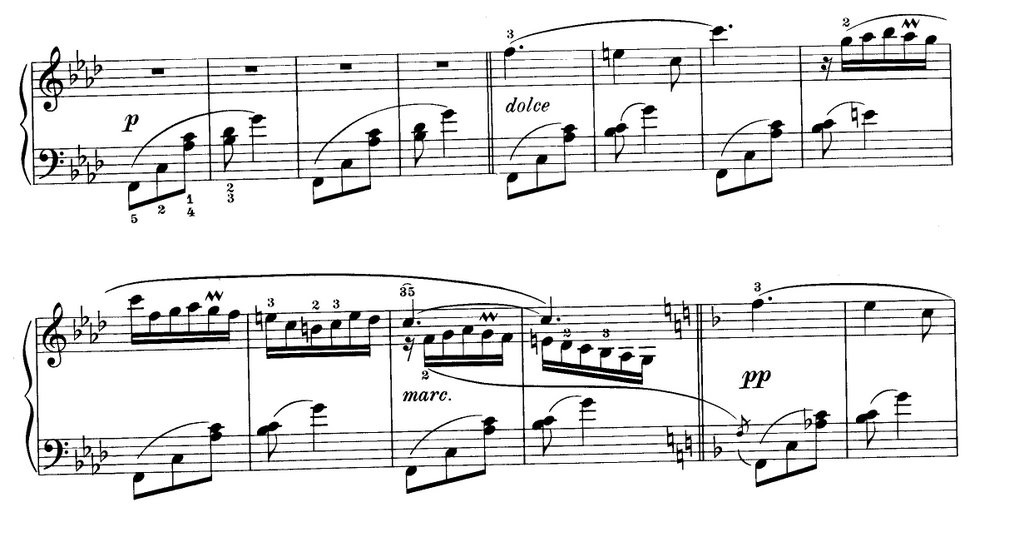
No, I'm not a pianist, but since this score is originally written for the piano, I guess I'll use the original piano score. The guitar transcription is transcribed a semitone lower, from the key of F to the key of E. I still sincerely believe that this work is written with the sounds of the spanish guitar in mind, for it truly sounds better on the guitar compared to the original instrument for which it is written for.
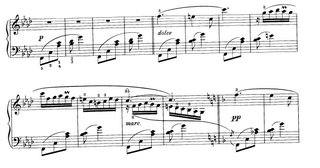
This is the start of his "middle section", the modulation into the key of F min. This dreamy section of the work momentarily transports the listener to the most tranquil and serene streets of Granada in the evening. Maybe it wouldn't be right to classify bars 41 to 44 (the first 4 bars above) as the middle section, as they form the transition bars from the opening section in F maj to the middle section in F min. The first section describes of the hustle and bustle of the streets during the day (for once, crowds are actually so lovely with the hills and mountains of Sierra Nevadas as the background) and as the night falls (as shown the the first 4 bars above), the intrinsic charm of the province reveals itself...
The F min chord in the lower registers progressed in such a lovely, misty manner into the G dim chord in the higher registers of the instrument in the first 4 bars here shown here. Nope, the noise from the day hasn't completely disappeared, but the crowds are either starting to go back home for dinner or head to the nearest taverns for a drink. And then from bar 45 time stops. Alright, that's not much of a description, but I thought that pretty much sums it up. Doesn't that how one feel when one behold the most alluring sight like the Alhambra? The repetition of the motive from bars 48 to bars 50 in various forms throughout the middle section. Somehow the composer is trying to recapture the very honest emotions which struck him when he was walking along the streets of Granada, beholding the picturesque surroundings of this most simple province in Andalusia.
Somehow, J captured the entire mood of this middle section upon the first listening when he opened himself up to the music. That remark was made with such honesty. Somehow, as a performer, it's truly satisfying to be able to touch the hearts of people and move them with my music.
No, I'm not a pianist, but since this score is originally written for the piano, I guess I'll use the original piano score. The guitar transcription is transcribed a semitone lower, from the key of F to the key of E. I still sincerely believe that this work is written with the sounds of the spanish guitar in mind, for it truly sounds better on the guitar compared to the original instrument for which it is written for.
This is the start of his "middle section", the modulation into the key of F min. This dreamy section of the work momentarily transports the listener to the most tranquil and serene streets of Granada in the evening. Maybe it wouldn't be right to classify bars 41 to 44 (the first 4 bars above) as the middle section, as they form the transition bars from the opening section in F maj to the middle section in F min. The first section describes of the hustle and bustle of the streets during the day (for once, crowds are actually so lovely with the hills and mountains of Sierra Nevadas as the background) and as the night falls (as shown the the first 4 bars above), the intrinsic charm of the province reveals itself...
The F min chord in the lower registers progressed in such a lovely, misty manner into the G dim chord in the higher registers of the instrument in the first 4 bars here shown here. Nope, the noise from the day hasn't completely disappeared, but the crowds are either starting to go back home for dinner or head to the nearest taverns for a drink. And then from bar 45 time stops. Alright, that's not much of a description, but I thought that pretty much sums it up. Doesn't that how one feel when one behold the most alluring sight like the Alhambra? The repetition of the motive from bars 48 to bars 50 in various forms throughout the middle section. Somehow the composer is trying to recapture the very honest emotions which struck him when he was walking along the streets of Granada, beholding the picturesque surroundings of this most simple province in Andalusia.
Somehow, J captured the entire mood of this middle section upon the first listening when he opened himself up to the music. That remark was made with such honesty. Somehow, as a performer, it's truly satisfying to be able to touch the hearts of people and move them with my music.
Sunday, July 09, 2006
Interpretation of Baroque Music
Despite being in an era which the classical music community shifts their focus to the historically informed performances, it isn't very rare for one to come across a recording or performance which romanticises Bach. Recall about the number of times when you hear a traditionalist, probably yourself, remark in disgust that the performance is overly romanticised. Common, aren't they? Recently, I've been thinking if such remarks and criticisms are justified. Of course, I do admit that I'm a traditionalist and the period and style which I have the most number of interpretation books on is the baroque era. And with the information I have received from these books alone, it wouldn't be too difficult to assess if a performance or recording is within those traditional baroque performance guidelines. But from a perspective of a performer, are things really that simple?
In my discussions with several friends who are musicians involving performances of baroque pieces which we have gone to, I would often approach their criciticisms of romanticism of the music with caution. I have experienced that some of these comments are uttered whenever the performer had expressed or rather, intensified, a certain emotion in the passage through the use of more modern devices such as excessive ritardando or accelerando, or wide dynamic contrasts which are often associated with romantic works etc. Somehow, such reasons doesn't quite register as a convincing argument to dismiss certain performance.
The more legitimate approach, it seems, would be to assess the intention of the performer when he used that expressive device. If those devices are simply used without much consideration to entire texture of the work and doesn't blend into the whole picture, the insincerity of the performance can be easily felt and that is definitely unacceptable. Of course, on the other hand, despite me being a traditionalist, there're romanticised performances of baroque pieces which I'm totally agreeable with. The non-conventional expressive devices used are just what the music can tolerate with, or even require. The performance, despite a non-conventional one, is widely accepted, even by traditionalists as listeners can connect with the artiste because of his/her sincerity and sensitivity to the music.
Basically, I just think that music listeners ought to approach this age old issue with more sensitivity and depth for most of the performers out there have put in so much effort to interpret a piece of music they respect and shouldn't be criticised simply because of the usage of non-conventional expressive devices which intensifies the emotions which the composer had intended centuries ago.
In my discussions with several friends who are musicians involving performances of baroque pieces which we have gone to, I would often approach their criciticisms of romanticism of the music with caution. I have experienced that some of these comments are uttered whenever the performer had expressed or rather, intensified, a certain emotion in the passage through the use of more modern devices such as excessive ritardando or accelerando, or wide dynamic contrasts which are often associated with romantic works etc. Somehow, such reasons doesn't quite register as a convincing argument to dismiss certain performance.
The more legitimate approach, it seems, would be to assess the intention of the performer when he used that expressive device. If those devices are simply used without much consideration to entire texture of the work and doesn't blend into the whole picture, the insincerity of the performance can be easily felt and that is definitely unacceptable. Of course, on the other hand, despite me being a traditionalist, there're romanticised performances of baroque pieces which I'm totally agreeable with. The non-conventional expressive devices used are just what the music can tolerate with, or even require. The performance, despite a non-conventional one, is widely accepted, even by traditionalists as listeners can connect with the artiste because of his/her sincerity and sensitivity to the music.
Basically, I just think that music listeners ought to approach this age old issue with more sensitivity and depth for most of the performers out there have put in so much effort to interpret a piece of music they respect and shouldn't be criticised simply because of the usage of non-conventional expressive devices which intensifies the emotions which the composer had intended centuries ago.
Subscribe to:
Posts (Atom)