My fellow readers, I'll be going to Europe for a vacation for the next month. Finally, a chance to escape from this cage...
Shall talk more about it when I come back... =)
Sunday, March 25, 2007

Wednesday, March 21, 2007
A Spiritual Journey With Bach
Ich habe genug,
Ich habe den Heiland, das Hoffen der Frommen,
Auf meine begierigen Arme genommen;
Ich habe genug!
Ich hab ihn erblickt,
Mein Glaube hat Jesum ans Herze gedrückt;
Nun wünsch ich, noch heute mit Freuden
Von hinnen zu scheiden.
I have enough,
I have taken the Savior, the hope of the righteous,
Into my eager arms;
I have enough!
I have beheld Him,
My faith has pressed Jesus to my heart;
now I wish, even today with joy
To depart from here.
The above text is from the first aria from Bach's Cantata BWV 82 - Ich Habe Genug (I Have Enough). I didn't know what made me pick up a recording of this from my shelves last night and play it on my CD player. But I do know that just a mere first few bars into this piece, I felt an overwhelming sense of pathos to this most spiritual work. The first few bars alone gave an unmistakable idea that I was at a start of an intense spiritual journey. In certain sections of this aria, the music reaches a point of anguish and restraint, but not to the extent of losing that innately deep spiritual peace when having our hearts facing towards our Saviour.
How much I love the sound of the oboe d'amore played by Peggy Pearson and how captivating the unique tones of the voice, oboe d'amore, strings and the organ gives the entire work a most sombre quality. The static bass line used by Bach seems to restrain movement of the aria, seemingly to imply that death is eminent. Such a powerful and masterly manner Bach had used this device! I could go on and on about what I felt from just the first aria, but I guess I'll spare everyone of my excessive outpouring of emotions here.
I have to admit that so long after Serene had given this to me as a gift, I have been unable to see anything deep about this work until last night and thus chucked it aside for quite some time until
I felt an invisible urge to play the CD last night. A million thanks to Serene for this gift of a CD by Lorraine Hunt Lieberson. I'm now one of the victims of her amazing artistry. Such a gift of being able to make her music come to life. A quote by Peter Sellars, who did the staging of the two cantatas in the CD featuring BWV 82 and BWV 199.
The passage of this piece is taken from Luke 2:22-32 and it focuses on Simeon, to whom it has been revealed by the Holy Ghost that "that he should not see death, before he had seen the Lord's Christ." The work is then the contents of Simeon's beatific prayer:-
Luk 2:29 Lord, now lettest thou thy servant depart in peace, according to thy word:
Luk 2:30 For mine eyes have seen thy salvation,
Luk 2:31 Which thou hast prepared before the face of all people;
Luk 2:32 A light to lighten the Gentiles, and the glory of thy people Israel.
Such sincere words fixed to such sublime music. Such beauty.
Ich habe den Heiland, das Hoffen der Frommen,
Auf meine begierigen Arme genommen;
Ich habe genug!
Ich hab ihn erblickt,
Mein Glaube hat Jesum ans Herze gedrückt;
Nun wünsch ich, noch heute mit Freuden
Von hinnen zu scheiden.
I have enough,
I have taken the Savior, the hope of the righteous,
Into my eager arms;
I have enough!
I have beheld Him,
My faith has pressed Jesus to my heart;
now I wish, even today with joy
To depart from here.
The above text is from the first aria from Bach's Cantata BWV 82 - Ich Habe Genug (I Have Enough). I didn't know what made me pick up a recording of this from my shelves last night and play it on my CD player. But I do know that just a mere first few bars into this piece, I felt an overwhelming sense of pathos to this most spiritual work. The first few bars alone gave an unmistakable idea that I was at a start of an intense spiritual journey. In certain sections of this aria, the music reaches a point of anguish and restraint, but not to the extent of losing that innately deep spiritual peace when having our hearts facing towards our Saviour.
How much I love the sound of the oboe d'amore played by Peggy Pearson and how captivating the unique tones of the voice, oboe d'amore, strings and the organ gives the entire work a most sombre quality. The static bass line used by Bach seems to restrain movement of the aria, seemingly to imply that death is eminent. Such a powerful and masterly manner Bach had used this device! I could go on and on about what I felt from just the first aria, but I guess I'll spare everyone of my excessive outpouring of emotions here.
I have to admit that so long after Serene had given this to me as a gift, I have been unable to see anything deep about this work until last night and thus chucked it aside for quite some time until
I felt an invisible urge to play the CD last night. A million thanks to Serene for this gift of a CD by Lorraine Hunt Lieberson. I'm now one of the victims of her amazing artistry. Such a gift of being able to make her music come to life. A quote by Peter Sellars, who did the staging of the two cantatas in the CD featuring BWV 82 and BWV 199.
A little background of this work for some who might be interested, taken from the programme booklet.Her voice is filling the room and you don’t know where it’s coming from… She is going right to the heart of a suffering person, not to increase the suffering, but to heal it, to release it, to offer some kind of balm… which is what her voice ends up doing. It can be piercing and shocking in its intensity, and then this incredible balm of compassion and tenderness, of generosity that is poured out of her voice like a kind of liquid that is there to heal.
Peter Sellars
The passage of this piece is taken from Luke 2:22-32 and it focuses on Simeon, to whom it has been revealed by the Holy Ghost that "that he should not see death, before he had seen the Lord's Christ." The work is then the contents of Simeon's beatific prayer:-
Luk 2:29 Lord, now lettest thou thy servant depart in peace, according to thy word:
Luk 2:30 For mine eyes have seen thy salvation,
Luk 2:31 Which thou hast prepared before the face of all people;
Luk 2:32 A light to lighten the Gentiles, and the glory of thy people Israel.
Such sincere words fixed to such sublime music. Such beauty.
Sunday, March 18, 2007
After Thoughts On A Rehearsal
After having the ensemble rehearsal, whereby we focussed on Mozart's Eine Kleine Nachtmusik, in the afternoon today, I felt that there was much more about the music which could be milked from the work and I hadn't done the work justice earlier.
In comparison with several of his other piano sonatas, I do find this work pretty straightforward, in terms of its harmonic language and structure. Simplistic yet charmingly elegant nonetheless. It does give me a hint that Mozart had composed this work as a break while working on a bigger work.
Scanning through the musical notes in the entire work, it probably wouldn't be difficult to analyse through this entire work. But when it comes to playing it, I do find that it's quite musically taxing on guitarists, who are mostly playing solo music, to come together to work on a chamber work after not having much experience playing together. It's quite an achievement getting the rough shape of the first movement out, but there's still lots of work on the balance, whereby every musician in the ensemble has to be musically developed to know when to hold back to let the other voices sing and when their own voice ought to stand up and fly. I really hope that the layers would be more transparent and while playing coherently with the intention of bringing out the charming beauty of this work, each individual section of the ensemble will know when to take centre stage and allow their parts to fly with the support of other sections.
Being one of the most famous pieces of classical work around, I do feel quite a big pressure to shape up this work. It would be the most glaring to the audience when anyone of us makes a small mistake. Come to think of it, if this piece is played badly by us, the audience would probably think that guitar ensembles in general are overly ambitious to take on such a transcription. On the other hand, when a string ensemble messes this up, the audience would normally just dismiss the particular string ensemble involved as being incompetent. Truly hope that we can allow this charming work to take flight.
As regarding the process of interpretation in our ensemble, I do hope that everyone can see the entire beauty of the work. I'm sure disagreements in the interpretation of a particular work or passage would arise, but I hope to be able to put them up for discussion so that they will be ironed out with everyone being satisfied at the end of the day. Essentially, I hope that we can bring our audiences into an altered state when listening to our ensemble rendition of this charming serenade.
When it comes to chamber music, the group that comes into my mind is actually the Collegium Vocale Gent. I'll never forget the most intense experience I felt that night in the Esplanade Concert Hall when the small group of ensemble manage to touch the souls of their listeners with their masterful interpretations and pure sounds. I shan't blabber on about that again, but certainly hope that we can reach that level within the next few years.
I can't help but admit that I like this work more the Isaac Albeniz's Sevilla. Well, it isn't to justify why I didn't practise much on the latter recently, but I hope to be able to devote equal amount of dedication to the various ensemble works when I come back. Would be planning to work an hour or two daily on just ensemble pieces to ensure that my section would be musically mature and sensitive to our roles in all the various sections of the works as well.
**For those invisible readers who attended the rehearsal today, do give comments about this session so that everyone can know how to improve and focus on for the subsequent rehearsals after that. I'm not sure how receptive everyone is, but I certainly hope that it can kickstart the interpretation processes which is desperately needed by the music, not merely working on playing the notes individually every rehearsal.**
Tuesday, March 13, 2007
Back At Home
After a few twists and turns of a mixture of Schubert, Mozart, Rodrigo and a few other lesser known composers, I found myself picking up Bach again. Beneath the Bachian structure and order hides a wealth of the most colourful emotions. Such blissful indulgence.
Upon my music stand now is the Gavotte from Bach's Lute Suite BWV 1006a. Come to think of it now, isn't that what I've worked through half a year back?!? The process of re-working through this music on my new instrument has revealed to me another level of beauty into the piece. It does seem technically overwhelming when beholding such musical depth into this work, especially when I have such a dying desire to bring out the beauty.
The campanella passages on the guitar sounded so charming! (Campanella is a composition device which involves the execution of an arpeggic passage of similar notes on several courses, more commonly known as strings today, of the instrument, resulting in a most charming confusion of tone colours. It is pioneered by the early baroque composers for the baroque guitar. If I don't recall wrongly, it was first mentiond by Luis Garcia-Abrines in his instruction for Spanish guitar playing.) I realised how much I had been missing out on with my previous ill-intoned instrument. Can't wait to pick up the Prelude of this Suite, which I've been putting aside due to my past inability to play those campella passages in tune (which can be incredibly irritating). And now, the smell of freedom, when I'm no longer restricted by my instrument.... How blessed I am, I'm so thankful!!
Hopefully that's a piece I can prepare in time for the musical soiree this coming Saturday with some fellow musician friends.
Like a musical work which starts in the tonic key and ends in a tonic key, I've landed back at Bach again, feeling all refreshed and at home again...
Saturday, March 03, 2007
A Little Anguish
Been working on the first movement of the Arpeggione Sonata these few days. I managed to get the entire first movement out under my fingertips, and I'm currently shaping it up and getting myself ready for playing together with the accompaniment.
While running through the piece a few times, I always felt a little strange playing the first climax in the exposition section after the 2nd theme has been introduced. I kept running through that portion over and over again. At snail speeds, at leisurely speeds, at breakneck speeds,syncopatedly, with some rhythmic alteration, softly, loudly. Fought with my new guitar and tried so hard to wrench an anguished cry for the climax but the guitar just refused to co-operate. She was unbelievably nonchalant. Finally, I gave up and decided to give us a little more time to try and get along before working at it again. (Ivan, it might be the machinehead...)
In the meantime, I went back to the original urtext edition published by G. Henle Verlag for Violoncello and Piano and got a little surprise.
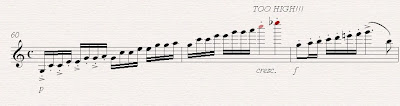
It's pretty unfortunate that the upper range of the arpeggione is a little too high for the guitar. Guess how did John Williams transcibe it. He actually changed that high C to a G (to suit the style of the running scalic passage before that) and the high Eb to a F# an octave lower (to prepare for the scalic passage the bar after). As such, the climatic point was prematured - 1 crochet and 1 semiquaver beat earlier. How frustrating... I guess it can't be helped, with the tonal range I am given on my instrument. But I can't get over the fact that it's the climax that has been tempered with. There're still other sections whereby the arpeggione part and the piano part has been switched due to the limitations of my instrument.
Can't help feeling a little indignant... Just hope that my new guitar can mature to be a little more co-operative soon...
Sorry, Schubert, for desecrating such a masterpiece of yours...
While running through the piece a few times, I always felt a little strange playing the first climax in the exposition section after the 2nd theme has been introduced. I kept running through that portion over and over again. At snail speeds, at leisurely speeds, at breakneck speeds,
In the meantime, I went back to the original urtext edition published by G. Henle Verlag for Violoncello and Piano and got a little surprise.

It's pretty unfortunate that the upper range of the arpeggione is a little too high for the guitar. Guess how did John Williams transcibe it. He actually changed that high C to a G (to suit the style of the running scalic passage before that) and the high Eb to a F# an octave lower (to prepare for the scalic passage the bar after). As such, the climatic point was prematured - 1 crochet and 1 semiquaver beat earlier. How frustrating... I guess it can't be helped, with the tonal range I am given on my instrument. But I can't get over the fact that it's the climax that has been tempered with. There're still other sections whereby the arpeggione part and the piano part has been switched due to the limitations of my instrument.
Can't help feeling a little indignant... Just hope that my new guitar can mature to be a little more co-operative soon...
Sorry, Schubert, for desecrating such a masterpiece of yours...
Friday, March 02, 2007
And Now For The Chaconne
I've been putting it off for too long a time, for fear of desecrating this magnificent masterpiece. Every session of analysing through this work in the past year or so often ended up in a regret that I am not technically proficient yet and also because of the lack a convincing instrument to bring out the beauty of this spiritual masterpiece. Right now, the latter hurdle has been cleared. I'll be be attempting to pick this up in the near future...
I could hear the first 8 bars resound in my head, beckoning me to walk closer...
Irresistible, not because of the fact that it is a monumental work, but because of its wealth of emotional values and lessons I've gained by listening to it and analysing it (though such attempts often left me more perplexed than enlightened, even with something as simple as the re-occurance of the subject itself).
The work itself is a long, arduous journey. Listening to it has been such an insightful, life-changing experience. What about the process of learning, shaping and mastering it? And then how does it feel when I have the piece to come out of me?
Thursday, March 01, 2007
Picking An Instrument
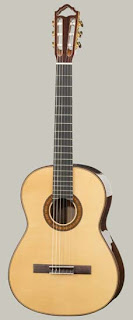
Checked out that beauty again in the shop at Esplanade today and I was more enamoured with the charming singing voice of her than ever. I knew that was the instrument that I wanted for myself, especially after trying out a range of instruments from S$3k to S$7k at another shop a few days back. Finally, I've found my guitar! Beneath her humble price tag of slightly below S$3k hides a most mesmerising sound. Of course, being with a badly-intoned instrument for the past 3 years, I was desperate to make sure I choose one which has a flawless intonation. As such, my requirements running through my head were as follows: flawless intonation, pure and refined voices from the lowest registers to the highest registers (I didn't believe I would come across such an instrument at this price range until I tried this instrument), versatility (a silky, velvety sound or a stunningly brilliant sound whenever the music calls for that sort of tone colour), a sound which seems to blossom over distance, a pure sound that allows the soft passages to project beautiful across a distance, responsive to the slightest changes in pressure and contact. Not to mention that the instrument has to be aesthetically pleasing as well. The beauty in the shop actually possess all of these rare qualities, at such a price.
Thanks to the immense generosity of Ivan, my fellow ensemble musician, and the kindness of the ladies tending the shop, I was able to get the beauty back home by paying for it with installments. Finally, a dream instrument to call my own! Shall work doubly hard on my technical and musical aspects to be a worthy owner of this instrument.
Thanks to the immense generosity of Ivan, my fellow ensemble musician, and the kindness of the ladies tending the shop, I was able to get the beauty back home by paying for it with installments. Finally, a dream instrument to call my own! Shall work doubly hard on my technical and musical aspects to be a worthy owner of this instrument.
Thursday, February 08, 2007
On The Arpeggione Again
I just received a note by Dr. Osamu Okumura, the president of the Arpeggione Society in Japan. What a pleasant coincidence that I'm actually working now on Schubert's most beautiful Arpeggione Sonata.
It's amazing how the only currently existing piece of music written for this instrument has piqued the curiosity of so many people around the world, to the extent of re-constructing this obsolete instrument. If I have a chance, I would certainly love to try out this instrument and learn to play this masterpiece this historical instrument. I had written an entry on this instrument when I was first seduced by the immense beauty of this work. Thankfully, the range of the arpeggione that is used in this work falls just barely within the range of the guitar that I am able to try my hands on such a gem and incorporate it into my repertoire.
No groundbreaking compositional techniques or strange harmonies used, but just simply charming. It isn't like Bach whereby I'm continually discovering new things about the works, but somehow, I can never get bored listening or playing this work, probably due to its seamless blend of a wide spectrum of emotions in such most poetic manner...
I'm still in the midst of studying this work. Analysing the entire harmonic structure and texture of this work. A not-so-easy task with the arpeggione being an obsolete instrument. But by studying his works which he had composed in the same period of his life, it does help me understand his style in this Arpeggione Sonata a lot more thoroughly.
Sunday, February 04, 2007
Revelation
I do believe that for most people, at some point of time or another, a random piece of music would start playing in their minds, probably as a subconscious reflection of what they're currently feeling.
I never could quite truly understand the value of the first movement of Bach's Sonata No. 1 in G minor for solo violin, BWV 1001, until tonight as I was walking home. Incidentally, this movement started playing on my mind just as I was on the way back earlier. Of all the music which would most possibly start playing randomly on my mind, this piece would probably rank as one of the least probable ones.
If you had asked me what I thought about this Adagio movement before today, I could never be able to comment more than the fact that it was deeper than what I was able to appreciate of it. A powerful and expressive improvisational touch with an unpredictable yet deeply emotional melodic line. I had naively believed that this movement would have been better composed with a more formal structure in order to retain its emotional value while preparing for the magical Fugue that comes. (Big talk from someone who doesn't have any gift of composition) Just twenty minutes ago, I was made to realise that this movement could never have been better.
In this movement, the unpredictability of the melody really is the eventual creation of one who laments the vulnerability of life to uncontrolled external circumstances. Such rich harmonies, conceived ahead of his time, further intensify the feeling of helplessness. Those numerous trills that scatter themselves all over the movement gives one the feeling of an unnatural suspension in mid-air. Not the sort of certain trills which resemble the sounds of nature, of birds singing. And not to mention that some of their resolutions aren't completely smooth and doesn't make one feel at home. And seemingly, after a most spiritual journey, one finds himself back on the same spot as he has started. Spending our lifetime walking in circles?
Somehow, I have a sudden craving to hear some Erik Satie. An atmosphere of a certain sadness and indifference... ending up in a completely foreign place at the end...
Friday, February 02, 2007
Oldest Existing Music?
Check this out.
For most of them who stubbornly believe the harmony was non-existent until nearly 2000 years ago... Wouldn't the most spiritual harmony of nature itself inspire humans to make music with harmony right from the first day of creation? And a 7-note scale existing even then...
For most of them who stubbornly believe the harmony was non-existent until nearly 2000 years ago... Wouldn't the most spiritual harmony of nature itself inspire humans to make music with harmony right from the first day of creation? And a 7-note scale existing even then...
Monday, January 22, 2007
A Closer Look
*Note written after the completion of this entry*An initial apology for the lazy and disorganised attempt at the review of the student concert...
Thankfully, the student concert went really well today. It was probably due my participation in the International Guitar Festival a month ago that made me appreciate the sheer amount of sleepless nights, missed meals and co-ordination to organise a concert. I really wanted to help out as much as I could to relieve the stress off Auntie Mei, even at the expense of straining myself a little before my item.
It was a pretty nerve-wrecking start, when fellow performers forgot their music or played a couple of wrong notes which sound like Schoenberg. Such instances sure encouraged the invasion of a dark thought that such instances would happen during my item as well, though I sure didn't voice it out loud like a few pretty amusing fellow performers in my same row. (On a minor note to avoid misconceptions, those ladies gave marvellous performances later on in the concert.)
Thanks to Guan Lin's most moving rendition of the largo and moderato cantabile sections of Chopin's famous Fantaisie-Impromptu, Op. 66, Nikki's ability to draw out the rich and colourful sonorities of the piano through Sibelius's Romanze in Db maj, Serene's charming performance of Schubert's famous Ständchen. the hauntingly evocative harmonies of Arensky's Impromptu played by Ursula and Omela's distinctively Spanish though slightly unstable rendition (probably due to nerves) of Albéniz's delightful Castilla from his Suite Espanola, that I could indulge in to calm my nerves down a little before my performance.
As I walked up on stage, I was slightly more concerned about the coming interval instead of my performance as I needed the toilet. As I started off the Tango, in the Allegro Moderato section, I was struggling to keep the rhythmic tempo of the tango for the dancers in the nightclub, in the midst of the various technical demands which has to be executed seamlessly while keeping the pulse of the tango going. It was the Lento section whereby I was momentarily transported as a time traveller and ghost spectator to the nightclub scene in Buenos Aires in the 1930s. And I had a crash transition from ending of that section to the recapitulation as my impotent fingers decided not to form that chord shape which has a magical effect of bringing the listener back to the dance floor. Well, as for the last section, I was half indulging in the stylistic delivery of the tango (thankfully no longer struggling), and half thinking about the toilet. How glamorous...
Well, for the later half of the concert, the two items which got me mesmerised were Aminah's most alluring French Horn performance and Guan Lin's sincere interpretation of The Romance of the Butterfly Lovers for piano. I was almost knocking myself on my head when I realised that I didn't have the chance to have Guan Lin as my accompanist for my exam because I had postponed it for a season.
All in all, it was a truly lovely afternoon of music, though marred by a not so appreciative audience and numerous mistakes probably caused by nerves. I could concentrate better on stage now, but I realised that I'm losing my tolerance for an audience who can't keep still and quiet in the most crucial and surreal moments of the music. We ought to have compulsory tranquilizers for such people...
Thursday, January 18, 2007
Such Honesty
It just struck me while I was going through some passages in Schubert's Arpeggione Sonata. (Please pardon me if I have been rambling on and on about this work for the past few weeks, months or even years. I'm continually unearthing something new every single time I pick up this work to study) Just from this small work of Schubert alone, he has exhibited such honesty in expressing and portraying the vulnerability and longing of each human soul in music. It really doesn't attempt to hide or dramatise anything. No pretension. No unnecessary superficial ornaments. No deception. Just a simple, forthright yet poignant presentation of such aspects of the human soul....
Oh, thank you so much, Schubert...
Oh, thank you so much, Schubert...
Tuesday, January 16, 2007
Performance Anxiety
"I had discovered the stage fright drug Inderal, or propanolol, which blocks the receptor site for adrenaline. Unlike anxiety medication like Valium, Inderel lessens physical symptoms without affecting the brain. I'd gotten mine over the counter in Ecuador, but Inderel is best prescribed by a doctor. Too many sends people with low blood pressure or asthma into a tailspin. But at least my nerves wouldn't flare up."
-Blair Tindell in Mozart in the Jungle
I have noticed that quite a number of professional musicians who rely heavily on such drugs like Inderel for their career and at the same time, several people who have commented that musicians who requires such drugs shouldn't even be performing at all. Apparently some harsh and critical comments they have there. It does seem that they relate a musician's right to perform to whether they take the drugs or not. Aren't their inherent musicality and musical accomplishments sufficient to justify their place on the concert stage? It's a pity when one looks back in history and realises that the devil had struck the king of Bach, Glenn Gould, with severe performance anxiety which forced him away from the concert stage.
I personally am blessed with a mild performance anxiety. More often than not, it does escalate a little more than which I would prefer but bananas would usually solve the problem. I do find that a slight anxiety, when my body releases a slight rush of adrenaline, is helpful in performance. It really does help when I can switch into an altered state without much difficulty. Simply an deep analysis of the musical work away from my instrument would throw me into an altered state, whereby I'm oblivious of everything else including time which bounds the majority of entire human race. However, on important performance occasions, I do bring a small dosage of Inderel with me, just to be prepared for the sudden, uncontrolled surge in adrenaline that I might have. I have never felt a need to use it though as bananas usually do the job of eliminating the minute shivering of the fingers which can heavily cripple a guitarist when a slight misjudgment of the frets or strings can cause the entire piece to break down or snap me out of my altered state.
All in all, I do certainly wish that Inderel shouldn't be treated with disdain by those blessed ones who do not require it. Although I do not rely on it as my main remedy to curb those fight or flight response symptoms, I do recognise its importance to fellow musicians who are crippled without it. Not that I would encourage it, but it should be administered with a doctor's advice to those who are severely affected by nerves.
Thursday, January 11, 2007
The Different Touch
I'm working on a few pieces recently, and in the midst of hopping between the pieces during my practice, I have found myself having very contrasting touch when approaching those pieces. It isn't very much an initial, conscious effort to produce that particular touch required for the music which is placed on the stand in front of me. To discover more about this (un)natural phenomenon, I dived into my inner world and tracked my subconscious way of functioning closely. Two pieces. Astor Piazzolla's Verano Porteño and Franz Schubert's Arpeggione Sonata.
As I take on the former, which is in the form of an Argentinian Tango, the sounds which I draw from my instrument are naturally raw compared to some mainstream classical works. I find myself visualising myself dancing, and upon reaching the offbeat accents, I would whisk my partner in an exciting and quick turn around the dance floor. It's probably due to my subconscious acknowledgment of the more exciting and surprising nature of those accents that gives rise to the raw touch.
In the latter, I was working on the first movement. Even if the music comes to an intense climax, I find the sounds which I attempt to caress from my instrument are well rounded and refined, seemingly trying to present those emotional moments in a more palatable and most poetic manner. In the sections leading up to those intense moments of the music, my fingers produced their most delicate touch and attempt an elegant dance above the strings. Dramatic still of course (as what Schubert would like to express), but in a special blend with musical poetry in the passages (as his usual distinctive style).
It certainly seems that the knowledge of the composers' lives, their compositional style and the societies in which they were living in does contribute to these subtle yet important variations in touch when playing their music. Passages with an almost similar texture and even harmonic progressions have different significances in different works and thus, are treated differently.
P.S: I would like to express my gratitude to a fellow musician based in Brazil, Xan, for helping me out with the pronunciation of Piazzolla's Verano Porteño and for all the information of the Latin American music which he has given me. That certainly helped in my interpretation and understanding of the music.
Monday, January 08, 2007
The Sound Of A Höfner
The Höfner guitar which stands in the Esplanade shop came up in our conversations again. I could still hear the deeply captivating sounds of that guitar even after my last encounter with it was more than a week back.
Just one of the three guitars that stands in that strings shop, the sound of it shines above all the guitars in the neighbouring guitar shop. The unmistakable heart-stirring basses of a German guitar, and the clear trebles that sings like a human voice. One look into the construction of the guitar reveals nothing new or special compared to the traditional fan bracing of Spanish instrument, neither is the back of the guitar made up of the best Brazilian rosewood (in fact just the common Indian rosewood), and it still intrigues the seasoned guitarists in the group that how the guitar can still sound so extraordinary.
If I have only five words to describe the sounds of this German Höfner, they'll be resonant, pure, refined, powerful and responsive.
It still falls short to traditional powerhouses like Paulino Bernabe and Manuel Contreras, but this is definitely a steal at such a price. No extra cost for banned wood, experimental ideas, just pure workmanship alone.
Subscribe to:
Posts (Atom)