The Vienna Boys Choir did a one-night-only concert today in Singapore today. Young boys with sweet and innocent voices. I just checked out some previews of the only CD they brought in today - Vienna Boys Go Pop. Thank God, that they didn't sing any of the pieces they sang in the most repulsive CD they ever made in history!
Let me do a review on the audience tonight for a change. It was full house tonight, not surprising for such a concert, given the amount of publicity they had weeks before. However, it seems to me that the audience in Singapore tonight just can't seem to appreciate the asthetic beauty of music. The repertoire tonight was filled with light-hearted and easy-to-appreciate pieces, with lots of Austrian folksongs and small lieders and hymns by prominent composers. Nothing too heavy. Claps coming in at the wrong time, the level of applause wasn't the least reflective of the level of music they sang etc. Tonight, we have the most unmusical audience who can't even hear the II-V-I perfect cadence ending and applauded without allowing the rest of the audience a chance to savour the precious last few seconds of the music. There's this group of audience who seem to indulge in the fact that an European choir is singing Eastern pieces. Of course, I do recognise the effort they put in but I seriously doubt that their rendition of eastern music in a strange accent with outlandish articulation was well, judging from the response of that group of audience, orgasmic.
But of course, I still enjoyed myself tonight with this simple performance by this lovely choir. =)
Wednesday, November 02, 2005

Friday, October 28, 2005
15th International Chopin Competition
News of the winner in this competition came to me pretty late due to the absence of an internet connection for the past week.

And so the first prize was awarded to Pan Rafal Blechacz from Poland, the birthplace of this Frederick Chopin. Interesting thing this year is that no 2nd or 5th prize was awarded. So do such results mean that they have a fixed criteria to attain those specific places? Dong Hyek Lim and Dong Min Lim from Korea were both awarded the 3rd prize, Shohei Sekimoto and Takashi Yamamoto from Japan were awarded the 4th prize and Ka Ling Colleen Lee from China was awarded the 6th prize. The first prize winner claimed the best performance of a polonaise, mazurka and concerto. Pretty stunning...
Really wish I could be there to listen live to his interpretation of Chopin's works. Shall be grabbing a copy of his CD when it comes out.
Maybe I'll be there to watch the competition in 5 years' time. =)
Sunday, October 23, 2005
Last Works of Beethovan and Schubert
The local classical radio station is currently airing a series of programmes from Deutsche Welle, Germany's public broadcasters, and earlier on I just tuned in to their Opus Ultimum - a series of programmes that broadcasts the final last works of great composers. The final works of the composers Ludwig van Beethoven and Franz Schubert were featured this week.
This is the first time I've listened to Beethovan's Grosse Fuge, a composition for string quartet. Remember the latest discovery of the piano version of this work last July? Originally written as a final movement for the String Quartet No. 13 (Op. 130), it wasn't well received by the public for the performers and public had expected something of light to conclude the suite. Of course, the radio station played the substitute movement, which was much simpler and more traditional in form as compared to this complex work. Eventually, the Grosse Fuge was published as a separate work, Op. 133. I'm captivated by the complexity of this work, with the disturbing dissonant harmonies and new composition techniques which are unconventional for that time. It just seems to me upon my first hearing that traditional classical composition techniques lie in ruins in this dramatic work, yet at the same time, there is this towering musical picture which is revealed within the work as the creativity of the composer gushed out. Apparently, Beethovan was traumatised by the attempted suicide of his nephew when he wrote this powerful masterpiece.
The next work featured was the last string quartet, the String Quartet No. 16 in F (Op. 135). An enigmatic piece when one compares it to his other late works. Nothing of the drama in his preceeding works. Simple and warm, yet a profound meaning is still present, especially in the last movement. In the manuscript, Beethovan wrote the question Muss es sein? (Must it be?) and answer Es muss sein! (It must be!) in the last movement. Cryptic words without any definite meaning at all. Upon listening to the whole work, it just seems to me that in the midst of writing this piece, Beethovan was questioning the purpose of existance and getting a conclusion before he finished this composition. =)
And then for the next hour, Schubert's 10th Symphony, or rather, Sketches of the 10th Symphony (D936a), song cycle Schwanengesang or Swan Song (D. 957) and sacred works (I couldn't catch their titles) were featured. The recording of the Sketches of the 10th Symphony captured my full attention for its whole duration. I tried looking up for more information online and what I've gotten is that the drafts for this work was discovered by Ernst Hilmar in the 1970s and Brian Newbould was the person who compiled the drafts and realised it as the 10th Symphony. Wonderously poetic music. I don't know what it is but there's just something special in his late symphonies and piano works, especially his late piano sonatas which draws me to them. Now now, if I ever acquire sufficient skills for a thorough analysis of music, Schubert's last piano sonatas will be the first few works I'll start attempting to understand.
Saturday, October 15, 2005
A Historic Discovery, in Beethoven's Own Hand
An interesting article on the discovery of an autograph manuscipt of the piano version of Beethoven's Grosse Fuge on the bottom shelf of a archival cabinet. A monumental work or transcription near the end of his life. =)
Here's the article.
Here's the article.
Friday, October 14, 2005
Nielsen's 'Inextinguishable' Symphony No 4, Op 29
Carl August Nielsen's 4 movement work - Symphony No 4, Op 29 'The Inextinguishable' was performed by the SSO tonight. And I'll have to admit that this is one wonderfully orchestrated twentieth century work by this Danish composer, though I thought that this work was rather primitive for its time.
This is a work written in the middle of the First World War and even in the first few bars of the first movement, the music doesn't attempt to mask the composer's personal opinions of the war. What captured my attention of the work tonight was the brilliant orchestration by Carl Nielsen. I attempted to travel deep into the different layers of the music instead of listening to the music as a complete whole and was well rewarded. Despite the drama created by the musicians as a whole, the superb orchestration was clearly evident. I have yet to listen to his other works, but if this symphony is characteristic of his general composition style, I wouldn't hesitate to say that he had this gift for instrumental colour and timbre. Throughout most of the entire work, the blending of the different instrumental colours was wonderful. It was only a particular section in the last movement of the work whereby the timbre and tone colours of the 2 sets timpani and violins clashes in the most awful way. Given the way in which the composer had written for most of the work, I would believe that such an awful blend would be a deliberate effect of the chaos in the war which the composer would like to express instead of careless orchestration. And of course, this dramatic section forms the last 'high' point of the entire work, when the image of a nihilistic perception gives way to a silver lining which symbolises hope. I haven't managed to get a chance to study the score yet, but that's what I could deduce from my first live hearing of this dramatic piece.
However, the orchestra was disappointing today. My guess is that the conductor and musicians are not exposed to twentieth century music as much as they ought to. They didn't seem to have a clear musical idea of several sections of this music. In some parts of the music, especially when it comes to the dramatic sections, the winds began to play as if the audience were deaf, blowing their guts out, overpowering the strings in the process and of course, those sections sounded brutal to the ear. I doubt that is what Carl Nielsen would have wanted, even though it is written on the war, for this essentially is music, and the musical shape shouldn't be compromised for bringing out the horrifying side of the war. Even within the fortissimo sections, a slight cresendo would have brought so much more musical value to the music instead of blaring the instruments at the top of its possible volume. I'm not sure if that's what the composer would have wanted, but I thought that the music could be more refined and musical without compromising any disturbing effects associated with the war. The tempo of the music also sounded problematic to me. Well, I can't explain how the tempo ought to be, for I've never seen the score nor heard a professional recording of it, but it sure sounded unnatural to me.
Besides this piece, the orchestra also played Jean Sibelius's Finlandia (Op 26) and Felix Mendelssohn Bartholdy's Piano Concerto No 1 (Op 25), with local pianist, Toh Chee Hung as the soloist. Well, the orchestra literally desecrated the former but manage to find their bearing back for the latter piece. An excellent piece for a casual teenage composition, though it wasn't anything near spectacular.
One interesting thing to note is that for all these 3 pieces tonight, the movements of each work is joined together without any breaks in between, at least for two of them, since Finlandia is a 1-movement work.
Well, despite the problems, I still thought that it was a good concert. Realise that for every concert I attend, I have learnt to appreciate the music played in a deeper manner instead of just admiring the work superficially. Thank God for opening my eyes, sharpening my ears and inputting the musical ideas into my mind.
Saturday, October 08, 2005
Göran Söllscher's Eleven String Baroque
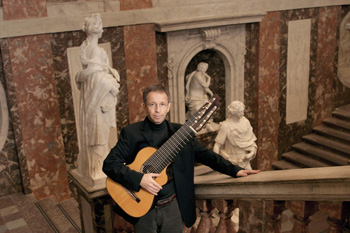
I'm truly captivated by Göran Söllscher's rendition of baroque pieces on this CD with his eleven string guitar. The music comes out perfectly natural and in the most musical way. Although he does take a little too much liberty with the rhythm, one is still feel the sincerity in his interpretation. The way he plays is never overpowering in terms of volume yet the music comes through to the listener with a powerful message, is extremely refined yet the expression of the music doesn't suffer. He just has this amazing gift of caressing such exquisite sounds out of his instrument. He truly has my utmost respect for his interpretation of baroque pieces.
Website
Sunday, October 02, 2005
The Big Problem
Have been reflecting upon the first atrocious run of my music in front of my friends yesterday. Was totally repulsed by the fact that that run could actually be so much worse than any of my practices a week ago. I thought back on the mentality I had when I was playing yesterday and realised that all I had in mind was perfection and being expressive. I had wanted to be in perfect control of every single aspect until I didn't give the music space to breathe. Even the minor technical hiccups became so blatant until the music can't continue at all.
Just felt so guilty, especially when it is Bach's music which I was playing. And I find myself terribly selfish, for I have gotten so much from the music, yet I am unable to produce it the way it ought to sound in front of an audience.
I was practising the same piece today in a public place and some people stopped to listen. Wasn't perfect, but it was definitely much more natural than yesterday. Maybe it's because I wasn't expecting anything much, and of course I felt much better. Maybe I ought to adopt such a mentality and let go of the control I normally have in my practices when performing in front of an audience. I can't imagine what would happen if I go up onto the stage and desecrate the music. Guess I really have to find my bearing soon, due to the examininations and competition I'll be taking part in next year...
Thursday, September 29, 2005
Guitar Transcription of Bach's Goldberg Variations

Haven't gotten the time recently to blog recently and wouldn't much much chance either for the next 4 months, but oh well, I'll just try to blog whenever I have the inspiration and a computer with internet connection.
Have been listening to Glenn Gould's 1981 recording of Bach's most gigantic composition for the harpsichord and I'm deeply drawn by the beauty of this work. Come to think of it, the way I've come into contact with this work has been really strange. I saw the guitar transcription of the Goldberg Variations in the local music store by József Eötvös and it actually stirred up my curiosity in this work, thus I went to acquire the legendary recording by Glenn Gould and I could say that was the most correct decision which I had made. And of course, I made my way down to that local music store to purchase the guitar transcription for it. I haven't gotten József Eötvös's recording of it yet, though I've listened to a few tracks in it, and I can only say that it's truly beautiful in its own way.
I'm indeed pleasantly surprised that József Eötvös had done the 'impossible' of transcribing this marvellous work by Bach onto a solo guitar. I wouldn't have gone down to purchase the score if it's a duo piece, for I wouldn't think that it's hard to transcribe a polyphonic piece onto two guitars, since Kazuhito Yamashita has managed to transcribe the whole work of Modest Mussorgsky's Pictures At An Exhibition and Igor Stravsinky's Firebird onto the solo guitar. Of course, certainly not an easy feat, but through the transcriptions, the architecture of these two orchestral pieces had suffered. But it's completely different for Bach's Goldberg Variations, which is written for a solo instrument - the harpsichord, for the guitar is also a solo instrument without sustain and a fairly quick decay of the sound.
I'm glad though, that József Eötvös had transcribed this work in a way such that it sounds like original composition for the guitar and not attempt to make the piece an imitation of the original. There are classical guitar recordings in which guitarists attempt to bring out the harpsichordic effect or make the guitar sound like a harpsichord. It desecretes the spirit of the guitar for the beauty of its natural sound is lost. What's the point of creating an authentic performance at the expense of the beautiful natural sound of the instrument? Bach himself had transcribed his works for different instruments and reworked them to suit the characteristic of the instruments anyway.
It's no wonder that this transcription has been hailed as the guitar transcription of the century, for this works seems more 'impossible' as compared to transcribing the whole Violin Partita No. 2.
I still hope to be able to complete one or two suites of Bach every year, so this work will probably have to wait a few years down the road, after I master the Lute Suites and probably a few of the Violin Sonatas and Partitas and Cello Suites.
It is, in short, music which observes neither end nor beginning, music with neither real climax nor real resolution, music which, like Beaudelaires's lovers, "rests lightly on the wings of the unchecked wind." It has, then, unity through intuitive perception, unity born of craft and scrutiny, mellowed by mastery achieved, and revealed to us here, as so rarely in art, in the vision of subconscious design exulting upon a pinnacle of potency.
-Glenn Gould, linear notes of the 1956 Bach Goldberg Variations
Wednesday, September 21, 2005
Joaquín Turina

After completing his musical studies with Vincent d'Indy at the Schola Cantorum in Paris, Joaquín Turina had composed his first piano quintet. In 1907, when Isaac Albéniz heard this piece in concert, he recommended his young colleague to focus his talent on Spanish folk music, especially flamenco music. In the next few years, Turina wrote a considerable number of piano pieces, songs and chamber works in which the spirit of the Spanish gypsies is evident. His Sinfonia Sevillana won a prize and he was given a professorial chair at the Madrid Conservatoire in 1930. Even then, he still remained faithful to the flamenco spirit in his compositions.
Even though his music is deeply influenced by his native Andalusian flamenco culture, there is still a presence of French impressionism in them, probably due to his acquaintance with French composers like Maurice Ravel and Claude Debussy. It's amazing how his music can evoke the most wonderful images of places in Andalusia. In most pieces, I can see myself walking through the streets in the evening, revelling in the historic magnificent structures around me. At the same time, the melancholy generated by the rich harmonies of the instruments is overwhelming beyond description.
Turina had written several pieces for the guitar due to the instigation of Andrés Segovia and these masterpieces by him bring out the essence of the flamenco culture. He has written a total of five works for the guitar - Sevillana, Op 29 (1923), Fandanguillo, Op 36 (1926), Ráfaga, Op 53 (1930), Sonata, Op 61 (1931), Homenaje a Tárrega, Op 69 (1932). Most of his guitar works are in the style of the flamenco dances, with their distinctive rhythms, and bring out the resonance of the spanish guitar in the most beautiful way.
Guess I'll start studying his musical style in general, before going into his guitar works, to prepare for the piece I'm chose.
XV International Frederick Chopin Piano Competition
Here it comes again. 3 more days to the opening of this renowned competition. Really wish I could be there to watch the competition. Who will emerge the winner of the this prestigious piano competition this year?
Tuesday, September 20, 2005
Apparent Intonation Problems
I was listening to Henryk Szeryng and Nathan Milstein's recording of Bach's Violin Partitas and Sonatas when I realised there was a slight intonation problem in one of the movements in BWV 1006. Towards the end of the movement, Nathan Milstein's recording started to sound a little flat. As I compared both of their recordings, they both started almost similarly. Yet, at the end, Milstein's recording became duller due to the flat intonation as compared to the other recordings of it that I have.
Oh well, maybe it's just a small intonation problem in this particular movement. He was supposed to be well known for his pure intonation anyway. Or maybe it's just my ears... Hmm...
Oh well, maybe it's just a small intonation problem in this particular movement. He was supposed to be well known for his pure intonation anyway. Or maybe it's just my ears... Hmm...
Monday, September 19, 2005
Preparation of Pieces
It's time to start organising what pieces to add to my repertoire for next year's competition, exams and events. And looking at the level of this year's competition, it's time for me to work extra hard.
For next year's exam, I've chosen 3 main pieces with 2 backup pieces in case I can't find a pianist for the chamber music and concerto. So they'll be Bach's Gavotte en Rondeau from BWV 1006a, Schubert's Arpeggione Sonata (1st movement), Rodrigo's Fantasia para un Gentilhombre (1st movement). The two backup pieces will be Tarrega's Capricho Arabe and Falla's Homenaje pour 'Le Tombeau de Claude Debussy'.
As for the competition, I'm still deciding between Turina or Ronaldo Miranda. I've ordered the Appassionata by the latter from overseas just two days ago and I've yet to see the score, but from what the way it sounds, it doesn't sound too easy. And until now, it seems that only Fabio Zanon's recording of it is in the market and I don't like the way he played this piece very much. But anyways, I'll try to master both pieces before the first quarter of next year, so I can have a choice for the competition. Oh, not forgetting the guitar duet. Haven't chosen a piece yet, but we've decided to start combining at the end of the year, in order to be in time for next year's competition...
That's all for now and several of these pieces are almost done except for several aspects which require finetuning. And of course, there's the theory aspect of music to tackle as well...
Saturday, September 17, 2005

Now, tonight is the highlight of this year's Guitar Festival. French guitarist Roland Dyens performed tonight. Now, for my review. If you haven't gone to his concert before, think of the best guitarist in your imagination, and I can only say that Roland Dyens is a much better guitarist than who you have in mind. I'm overly critical of performances most of the time, but the concert tonight has left me utterly speechless. Nothing I write would do justice to him.
Improvisation, musicality, technicalities, interpretation of guitar music at its peak. He didn't have a programme lined up, for he claimed that he wanted a spontaneaous concert suited for the atmosphere this night, with the element of surprise. I was skeptical about that at first, for how could some guitarist pick out random pieces that suit the atmosphere. I had actually shrugged it off as a promotional gimmick. But the concert tonight just made me feel so guilty of such thoughts I had. The music was totally spontaneous and natural, a quality lacking so badly in many professional concerts. Everything came out fresh and in the most special way...
The concert started off with a piece which he specially improvised for this concert in Singapore. It was totally magical, with its mystical and nostalgic mood, so often felt by one in a foreign land alone. Totally reflective of his mood I believe.
He just has this magical talent of producing the most beautiful musical effect out of the technical pieces which has practically no musical value in them at all. Somehow, from his concert, I have believed that no piece in this world is actually not musical at all... Oh well, guess that's something extreme I deduced from just one genius.
He's the first guitarist which will be listed under the section of virtuoso guitarists which I've actually met. He has managed to possess all of the diverse range of qualities used by the two schools of rational and intuitive performers . And yes, that pretty much makes him a prodigy. His music seems to be so well thought out and yet it still retains the natural, spontaneous quality to it.
Maybe all these may seem absurb to some. But I can only say that what I've written still doesn't do justice to his abilities... =)
A Night of Brazilian Music

Classical guitarist Fabio Zanon was on tonight. He started the concert wonderfully with 3 Latin-American pieces. The first piece is Triste no. 1 by composer Eduardo Fabini. An emotionally-charged piece of music to start off the evening and Fabio Zanon's style of playing brought out the spirit of the piece of music in the most wonderful way. The air resonates with the full spectrum of tone colours which he caressed out from his instrument, doing so with limited string noise. Such brazilian and Latin-American pieces fit just nicely with his personal style, though insufficient to recreate the atmosphere of Buenos Aires or Rio de Janeiro in the concert hall, but nonetheless enjoyable.
Also performing tonight is also special guest violinist Betina Maag Santos, who currently resides in Singapore. They performed the Sonata Concertata in A by Niccolo Paganini. Very lovely piece of music with its heartwrenching melody and warm harmonies. That sure inspired me to play some chamber music in the near future. And I've gotten quite some interesting chamber pieces to prepare for the exams and competition next year. Anyways, I was surprised to learn that Betina Maag Santos learned under the legendary violinist Nathan Milstein.
After the interval, 6 of the 12 Studies by Francisco Mignone was on. I have always been skeptical of studies or etudes being played in performances and recordings, for the intentions for which they are written for should restrict them to the practice room, unless the mastery of the particular technique involved creates a most beautiful musical effect. Stefano Cardi had played 1 of the 12 Etudes by Villa Lobos the day before and I thought it'd be better substituted with a standard performance piece. Yet tonight, the 6 Studies were mostly well chosen, and reflects aspects of the Brazilian musical culture.
The finale program piece was marred by the artiste's excessive emotions. Ever tried practising a romantic piece of music and attempting to make it more emotional by trying out different ways to express or shape the phrases, but end up with a repulsive version of it? That's what happened to Ronaldo Miranda's Appasionata. The excessive rubato and dynamic changes were too much and even though Fabio Zanon seemed to be totally immersed in the music, the music which had been produced was outright repulsive. Simplicity is the idea, and that's what the piece lacks. From what I deduced of the music from his playing, the melody line could have been really passionate if he had taken extra care to control the dynamic difference of his melody and harmony. That's also what I've observed from his style. The melodies of some of his pieces had been obscured due to the almost similar volume he plays his harmonies and as a result, sounding a little messy. IF one had sang the melody out mentally, he or she would have realised how musically beautiful the piece could be if several aspects of his playing could be refined.
I really wished he didn't play the two encore pieces, Torre Bermeja by Issac Albeniz and Serenata Espanola by Malats. He made us feel as if he was rushing to end this concert and the beauty of two Spanish impressionistic pieces were thus utterly destroyed in his hands. What a pity. If he could have sticked to the way he played at the first half, it would be a much better concertgoing experience for the audience who were present...
Somehow, his music didn't touch me as much as the previous two guitarists, but his technical capability impressed me the most, which is something very superficial... Nevertheless, I did enjoy tonight's concert. =)
Thursday, September 15, 2005
20th Century Guitar Music

An Italian guitarist, Stefano Cardi performed at the DBS Auditorium tonight. I'm glad it wasn't the concert hall, or probably more than half of the audience would not be able to hear such exquisite sounds of the guitar due to his light touch. Of course, when one talks of 20th century music, terms like atonality, avant-garde, experimentalism etc will come into mind, but nope, not for the classical guitar, which hasn't progressed as fast as the rest of the music world. Most of the music presented tonight was mostly tonal, except probably for one by Toru Takemitsu...
He started off with a pretty traditional piece by Manuel Ponce. It was a piece which was written in a Baroque dance style, for that's what Manuel Ponce was famous for, writing in the different styles of music back in history. The beginning of the performance was a little unsteady, but he settled pretty fast into the third piece. I was expecting music which were more dramatic and nonconventional, but was treated to a night of largely harmonious music. I really like his light touch, which was really pleasant to the ears.
It was Toru Takemitsu's kind music which I had been expecting. Mostly dissonant sounds, but it's truly a pleasure to listen intently into how the vibrations interact with each other to bring out the atmosphere. Seriously, if I had just switched off because of the dissonances, I wouldn't certainly have dozed off. Thankfully, I have listened to sufficient modern music to be able to appreciate such pieces. I sincerely enjoyed that piece, but I also happened to notice that the applause wasn't that enthusiastic after that. Guess the audience tonight wasn't able to connect as well... Would it be the same if he had played that piece in Europe?
Stefano Cardi also played two pieces by this Chinese composer Shih Hui Chen. Either he couldn't bring the oriental side of the music out well, or that the composition itself was problematic. But since he was reading from the score for this piece, I guess he wasn't too familiar with it as well...
Most of the pieces he played were written by great melodists in the 20th century and Stefano Cardi has certainly brought out the lovely melody lines with the most crystal clear tone. The problem he had was the boisterous string noise which sticks out like a sore thumb in his music. It has been possible to reduce, if not eradicate the string noise which is extremly unmusical. I don't know, but classical guitarists ought to start spending some effort on taking out this problem before we can even start comparing ourselves to the other classical instruments.
Another problem he had was the slight articulation problem in selected parts of the pieces. And towards the end of the concert, he didn't quite give the music time to breathe. At points where a fermata is needed, he just went straight on to the next section. It was a crucial pause which allows the audience to indulge in the emotions they're feeling at the point, and would have been so much more perfect if he had given the music a little more time to breathe.
Stefano Cardi played two encores, the first is his composition for Fritz Kreisler. A sweet and wonderfully tonal composition. The next is his transcription of Fritz Kreisler's famous Joy of Love. Yes, I can probably guess that he is a fan of Fritz Kreisler. =)
Subscribe to:
Posts (Atom)