The guitar repertoire contains quite a number of works which were written for the late Andrés Segovia by various composers. In most of these works with the exception of those by guitar composers, Segovia often took up the job of devising his own fingerings before having the music published. Unfortunately, I've often found that his publishings are most of the time unsatisfactory and more often than not, unreliable. Besides the usual printing errors found in them, Segovia had the bad habit of changing many details in the works which he was dealing with, even to the extent of changing the melodic and harmonic structure of the work.
The most unfortunate fact is that the publications of many works written for him has been founded upon his own texts, and thus, his publication of a particular work is the only version of the work available. Also, the publisher, Schott doesn't seem to be interested in re-publishing the works in a more accurate manner. As such, the process of learning those music often involves a very tedious process of analysing the work to sieve out the more obvious problems and at the same time, sections which are open to interpretation.
In one of such published work of Joaquin Turina I've taken up recently, I've the honour of having the fascimile manuscipt of the work sent to me by the kind Maestro Angelo Gilardino (guitar composer and musicologist). Upon comparison, I realised that there're quite a number of errors whereby sharps and flats are left out and Segovia had actually changed the performance directions which include the dynamics, phrasings and articulation. On top of that, he had actually taken out a bar in the second movement of the work. Sacrilege! And not considering that the fact that the changes he made didn't yield any beautiful musical effects at all...
I'm glad Maestro Angelo Gilardino is currently attempting to rescue all the original manuscripts of those works and publish them. It would be such a consolation for musicians who just have to work with the initial purest state of the work without any filth added in them.
Tuesday, January 10, 2006

Sunday, January 08, 2006
A Musical Gathering
It's my first musical gathering which I've attended upon invitation. What a lovely environment among people who love music coming together to play lovely chamber and solo music. Isn't it such a beautiful feeling shutting the whole world out and indulging in just making the music amongst ourselves? Besides playing and listening to our music, we share our thoughts and comments on the music as well.
It's been raining the whole day here and I'm truly thankful to spend such a enchanting afternoon in the cosy company of friends who love music. Maybe I should organise another musical gathering and invite friends who share a common passion for music together... =)
It's been raining the whole day here and I'm truly thankful to spend such a enchanting afternoon in the cosy company of friends who love music. Maybe I should organise another musical gathering and invite friends who share a common passion for music together... =)
Sunday, January 01, 2006
Music To Start Off 2006
I've been cracking my head on how to spend a meaningful new year's eve this year for the past few days. Well, I could join the ranks of people who have nothing better to do and head down to Mount Faber for the biggest local countdown party, or go for my class outing, or join my group of friends who're having a small countdown party. Finally, I've decided to distance myself from the superficial mundanity of the world and focus on the things which are the most dear to me - God and music.
As for the music aspect, I've decided to start on a piece of music which I had always wanted to start but hadn't found time for it. Originally planned to choose some passionate Spanish dance music like the Danza from Manuel de Falla's one-act opera, La Vida Breve, but was browsing through my collection of CDs when I chanced upon the recording of Heitor Villa-Lobos's Bachianas Brasileiras No. 1, 2, 5 & 9, conducted by the composer himself. The elegant and exquisite Aria (Cantilena) from his Bachianas Brasileiras No. 5 caught my full attention and demands that I start on it at that very moment.
Heitor Villa-Lobos is a towering figure in the history of Brazilian music and in this series of music, as the title suggests, fused the soul of Brazil with the spirit of Bach, whom the composer had a deep respect for. This particular fine masterpiece is originally scored for a soprano and eight cellos. The soprano sings a hauntingly beautiful melody of without an identifiable form, remotely resembling the Air in Bach's Third Suite. In the central section, the soprano intones a poem about the charming beauty of twilight, supported by expressive chromatically descending chords. Such immensely expressive music never fails to warm a cold, desensitised heart.
In my sheet music collection, I have two versions of it, one rescored for a soprano and guitar by the composer himself and one rescored for a solo guitar by virtuoso French guitarist Roland Dyens. Shall start on the former as it gives me a better idea of the layers of the music and not to mention the fun of playing chamber music.
English translation of text:
In the evening a rosy cloud, slow and lustrous,
floats across the lovely dreaming sky.
In its infinity the moon gently rises,
glorifying the evening, like a tender girl
who dreamily decks and adorns herself,
longing in her soul to appear beautiful
and crying to heaven and earth, to all Nature!
The birds cease singing their sad laments
and the sea reflects all its riches...
Softly now the moonlight awaits
cruel memories of laughter and tears!
In the evening a rosy cloud, slow and lustrous,
floats across the lovely dreaming sky.
As for the music aspect, I've decided to start on a piece of music which I had always wanted to start but hadn't found time for it. Originally planned to choose some passionate Spanish dance music like the Danza from Manuel de Falla's one-act opera, La Vida Breve, but was browsing through my collection of CDs when I chanced upon the recording of Heitor Villa-Lobos's Bachianas Brasileiras No. 1, 2, 5 & 9, conducted by the composer himself. The elegant and exquisite Aria (Cantilena) from his Bachianas Brasileiras No. 5 caught my full attention and demands that I start on it at that very moment.
Heitor Villa-Lobos is a towering figure in the history of Brazilian music and in this series of music, as the title suggests, fused the soul of Brazil with the spirit of Bach, whom the composer had a deep respect for. This particular fine masterpiece is originally scored for a soprano and eight cellos. The soprano sings a hauntingly beautiful melody of without an identifiable form, remotely resembling the Air in Bach's Third Suite. In the central section, the soprano intones a poem about the charming beauty of twilight, supported by expressive chromatically descending chords. Such immensely expressive music never fails to warm a cold, desensitised heart.
In my sheet music collection, I have two versions of it, one rescored for a soprano and guitar by the composer himself and one rescored for a solo guitar by virtuoso French guitarist Roland Dyens. Shall start on the former as it gives me a better idea of the layers of the music and not to mention the fun of playing chamber music.
English translation of text:
In the evening a rosy cloud, slow and lustrous,
floats across the lovely dreaming sky.
In its infinity the moon gently rises,
glorifying the evening, like a tender girl
who dreamily decks and adorns herself,
longing in her soul to appear beautiful
and crying to heaven and earth, to all Nature!
The birds cease singing their sad laments
and the sea reflects all its riches...
Softly now the moonlight awaits
cruel memories of laughter and tears!
In the evening a rosy cloud, slow and lustrous,
floats across the lovely dreaming sky.
Saturday, December 31, 2005
March No. 1 "Elemental Stage"
Went to the premiere of a composition, March No. 1 "Elemental Stage", by a local composer, Wong Kah Chun yesterday. It was played by the alumni band of the school which I graduated from three years ago. As written in the programme notes, this piece is the first in a series of future compositions whereby the limitations of the march are explored in great detail. In his first march, he toys around with bitonality in various sections of his music.
I would believe the performance last night wasn't quite up to his expectations due to the unbalanced proportion of the sections of the band, not to mention that the musicians themselves aren't seasoned performers.
Nonetheless, it's a pretty interesting work and I'm looking forward to his future marches. His March No. 3, with an enigmatic title, "Project L", will be slated for an informal recording next week. I shall attempt to take time off to attend the session.
I would believe the performance last night wasn't quite up to his expectations due to the unbalanced proportion of the sections of the band, not to mention that the musicians themselves aren't seasoned performers.
Nonetheless, it's a pretty interesting work and I'm looking forward to his future marches. His March No. 3, with an enigmatic title, "Project L", will be slated for an informal recording next week. I shall attempt to take time off to attend the session.
Monday, December 26, 2005
Mozart's 250th Anniversary
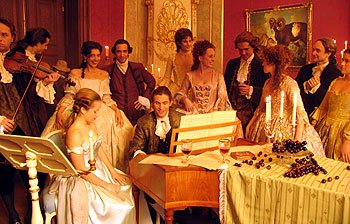
Scene from the new Mozart promotional film (Taken from here.)
The coming year 2006 marks the 250th anniversary of the birth of the most famous Austrian composer of all time - Wolfgang Amadeus Mozart. Plans are in place for a whole string of activities to commemorate his 250th anniversary in Austria next year and there promise to be both pomp and circumstance.
I personally don't quite like the idea of commercialising such a historic event with products bearing the name and pictures of Mozart stacking high along the streets all over Austria. It does seem to me that businessmen are sick of changing the image of their products so often to bear the image of pop stars and decide to turn to someone with a more lasting value.
Despite my discontentment at how some people treat this event, I would still very much love to make my way down to Salzburg to watch the performances devoted to this composer. Well, by the way, Salzburg will host a total of 260 concerts and 55 Masses devoted to Mozart's sacred music, including all his 22 operas performed at the Salzburg Festival next year. A sumptuous feast, isn't it?
Be sure to visit the website dedicated to Wolfgang Amadeus Mozart's 250th birthday - Mozart 2006!
Sunday, December 25, 2005
Christmas

Luke 2:11 For unto you is born this day in the city of David a Savior, which is Christ the Lord.
Christmastime is here again! A day to commemorate the most perfect gift given unto us by God - our beloved Lord Jesus Christ.
This Christmas, my school's choir has been scheduled to carol at Fullerton Hotel for 5 days. Went down to catch one of their sessions and they sang pretty well despite the open acoustics of the hall, not to mention that they are singing more than 10 sessions in total. Besides the joy of meeting friends whom I haven't met for months, the mood that evening was absolutely peaceful and filled with love, away from the overly commercialised environment everywhere else.
It has been such a spiritually and emotionally satisfying Christmas this year, with the close company of God, lots of passionate sacred music, and sensible and matured new friends. =)
Monday, December 19, 2005
Scales Practice
It's been quite some time since I studied and analysed the left and right hand techniques of professional guitarists. Just thought of re-looking at their techniques today, with the hope of incorporating some of their better techniques into my own. As such, I pulled out every single DVD I have of professional guitarists from my collection of music materials to watch.
It came as a revelation to me that most of the differences in their techniques actually stem from their practice of scales. They probably don't practise much scales after turning professional, but I realised that the way their music sounds was still very much dependent on the way they had practised their scales in their youth.
I admit that I haven't been a strong supporter of scales practice before today, despite the fact that my teachers kept emphasising on their importance, which I only discovered today. Even if I were to practise my scales industriously before today, I wouldn't be able to perfect my technique for I didn't know the intricacies of the scale practice that I had to take note of. Comparing the way the different guitarists play, I realise that their overall poise and the amount of control they have over the music actually stems from their movements of the left and right hand movements (all the way from the upper arm to the last joint of their finger).
Most of the DVDs I watched were pretty disappointing. Of course, their music comes across to me as sincere, but I realise that there was 'something' which was holding them back in expressing the full spectrum of emotions in the music they play. And that 'something' was the technique based on the way they practised their scales. Strangely, after that, I just dug out all the scales requirement and started practising on them for hours, and thankfully, I had quite considerable progress.
However, I still wouldn't recommend musicians to whack the scales blindly and merely aiming for speed and 'surface fluency'. I now believe that scales practice is useful only when one has the correct aim of economy of finger and hand movement and at the same time, drawing out the best possible one and volume of the instrument at that particular speed.
It came as a revelation to me that most of the differences in their techniques actually stem from their practice of scales. They probably don't practise much scales after turning professional, but I realised that the way their music sounds was still very much dependent on the way they had practised their scales in their youth.
I admit that I haven't been a strong supporter of scales practice before today, despite the fact that my teachers kept emphasising on their importance, which I only discovered today. Even if I were to practise my scales industriously before today, I wouldn't be able to perfect my technique for I didn't know the intricacies of the scale practice that I had to take note of. Comparing the way the different guitarists play, I realise that their overall poise and the amount of control they have over the music actually stems from their movements of the left and right hand movements (all the way from the upper arm to the last joint of their finger).
Most of the DVDs I watched were pretty disappointing. Of course, their music comes across to me as sincere, but I realise that there was 'something' which was holding them back in expressing the full spectrum of emotions in the music they play. And that 'something' was the technique based on the way they practised their scales. Strangely, after that, I just dug out all the scales requirement and started practising on them for hours, and thankfully, I had quite considerable progress.
However, I still wouldn't recommend musicians to whack the scales blindly and merely aiming for speed and 'surface fluency'. I now believe that scales practice is useful only when one has the correct aim of economy of finger and hand movement and at the same time, drawing out the best possible one and volume of the instrument at that particular speed.
Melvyn Tan
The controversy over this Singaporean pianist who evaded National Service has been present for quite some time. Thought of penning my opinions over this issue as a Singaporean musician who is currently serving the much dreaded National Service.
For the benefit of those people who don't know about this issue, here a short biography of him. Melvyn Tan had moved to the Yehudi Menuhin School in Sussex, Britain, to pursue his music studies at 12. However, when he was supposed to return to Singapore at the age of 18 to serve the compulsory National Service, he was accepted in the Royal College of Music in England and decided to go against the law by not returning to serve in the military. Subsequently a year after, he renounced his Singaporean citizenship and since then, he hasn't been back until this year. And basically, he hasn't been setting his foot on his native soil for around 30 years.
When the news of his evasion of National Service first appeared in the headlines, letters of discontentment flooded in the media. When they were published, I was taken aback by the harsh comments that came in. Truthfully, when I first read the news of his evasion, I was surprised I could just shrug it off and chuck it away at the back of my head without feeling much contempt at all, given the fact that my pursuit of my music studies was impeded by these 2 years of National Service. I could roughly guess most of the hateful letters which came in were by those who are currently serving the military, but I never thought they were so unforgiving, to the extent of buying tickets for his concert just to go on strike over there. I just thought that given my circumstances, it was me who should be having such pathetic sentiments.
If they had thought that it was unfair, they can simply go do the same, can't they? It's not too hard to just absent yourself from the military by going overseas to do what you want, is it? Examine their actions a little deeper and it wouldn't take much to understand such feelings just stem from their cowardly nature, which stops them from deserting the military, and jealousy, which is such a perverse emotion found commonly in myopic people who are unable to look at the whole big picture.
As for Melvyn Tan, I admire him for his achievements and for his courage to pursue his own dreams instead of coming back to an organisation where everyone is forced to conform to the system. And no, I don't sympathise with him, instead, I sympathise with those who blasted out at him, for these people haven't been able to look at the whole picture and their opinions have exposed their most pathetic and unforgiving side of human nature.
It's a pity he cancelled his concert and withdrew from judging the National Piano and Violin Competition, for there're true music lovers who would want to attend the concert to enjoy the music. But I guess such actions of his are unavoidable, given the number of immature citizens we have here in Singapore.
For the benefit of those people who don't know about this issue, here a short biography of him. Melvyn Tan had moved to the Yehudi Menuhin School in Sussex, Britain, to pursue his music studies at 12. However, when he was supposed to return to Singapore at the age of 18 to serve the compulsory National Service, he was accepted in the Royal College of Music in England and decided to go against the law by not returning to serve in the military. Subsequently a year after, he renounced his Singaporean citizenship and since then, he hasn't been back until this year. And basically, he hasn't been setting his foot on his native soil for around 30 years.
When the news of his evasion of National Service first appeared in the headlines, letters of discontentment flooded in the media. When they were published, I was taken aback by the harsh comments that came in. Truthfully, when I first read the news of his evasion, I was surprised I could just shrug it off and chuck it away at the back of my head without feeling much contempt at all, given the fact that my pursuit of my music studies was impeded by these 2 years of National Service. I could roughly guess most of the hateful letters which came in were by those who are currently serving the military, but I never thought they were so unforgiving, to the extent of buying tickets for his concert just to go on strike over there. I just thought that given my circumstances, it was me who should be having such pathetic sentiments.
If they had thought that it was unfair, they can simply go do the same, can't they? It's not too hard to just absent yourself from the military by going overseas to do what you want, is it? Examine their actions a little deeper and it wouldn't take much to understand such feelings just stem from their cowardly nature, which stops them from deserting the military, and jealousy, which is such a perverse emotion found commonly in myopic people who are unable to look at the whole big picture.
As for Melvyn Tan, I admire him for his achievements and for his courage to pursue his own dreams instead of coming back to an organisation where everyone is forced to conform to the system. And no, I don't sympathise with him, instead, I sympathise with those who blasted out at him, for these people haven't been able to look at the whole picture and their opinions have exposed their most pathetic and unforgiving side of human nature.
It's a pity he cancelled his concert and withdrew from judging the National Piano and Violin Competition, for there're true music lovers who would want to attend the concert to enjoy the music. But I guess such actions of his are unavoidable, given the number of immature citizens we have here in Singapore.
Friday, December 16, 2005
Sensitivity
It does seems to me that people who are into serious classical music are more sensitive to their surroundings as compared to people who don't practise the arts at all. For some reason unknown to me, it is those people who practise the arts which are able to detect the first signs of emotional instability in another person. Also, while a musician indulges in the simple and harmonious sounds of nature and cringe at the repulsive, yet almost inaudible noise produced by machinery at a distance away, most people who aren't into music aren't affected emotionally in such a drastic way by such subtle sounds they hear.
It's amazing when I start thinking about how vulnerable I am to the surroundings. It truly makes me feel more human in this modernised society where people just overwhelm themselves with work which numbs the humanistic part of them. It's a truly spiritual experience when I can sit back and indulge in the simple and poetic sounds of nature everytime when people around are procrastinating about their day at work.
On the other hand, I have friends who are so into music at the other end of the spectrum, like trance, which I would classify it as a part of the minimalist movement. Such music (if you would want to call them music in the first place) functions in a totally different way. I haven't gotten down to expose myself to trance music for hours but from their experiences, they said that overlistening just numbs thems and when people ask them what have they been listening to, they couldn't quite answer. It seems to tell me that such music desensitises people instead of heightening their senses like what traditional classical music do. A little of it would help one appreciate the subtleties of sound, but excessive exposure merely desensitises the person I guess.
It's amazing when I start thinking about how vulnerable I am to the surroundings. It truly makes me feel more human in this modernised society where people just overwhelm themselves with work which numbs the humanistic part of them. It's a truly spiritual experience when I can sit back and indulge in the simple and poetic sounds of nature everytime when people around are procrastinating about their day at work.
On the other hand, I have friends who are so into music at the other end of the spectrum, like trance, which I would classify it as a part of the minimalist movement. Such music (if you would want to call them music in the first place) functions in a totally different way. I haven't gotten down to expose myself to trance music for hours but from their experiences, they said that overlistening just numbs thems and when people ask them what have they been listening to, they couldn't quite answer. It seems to tell me that such music desensitises people instead of heightening their senses like what traditional classical music do. A little of it would help one appreciate the subtleties of sound, but excessive exposure merely desensitises the person I guess.
Wednesday, November 02, 2005
Vienna Boys Choir
The Vienna Boys Choir did a one-night-only concert today in Singapore today. Young boys with sweet and innocent voices. I just checked out some previews of the only CD they brought in today - Vienna Boys Go Pop. Thank God, that they didn't sing any of the pieces they sang in the most repulsive CD they ever made in history!
Let me do a review on the audience tonight for a change. It was full house tonight, not surprising for such a concert, given the amount of publicity they had weeks before. However, it seems to me that the audience in Singapore tonight just can't seem to appreciate the asthetic beauty of music. The repertoire tonight was filled with light-hearted and easy-to-appreciate pieces, with lots of Austrian folksongs and small lieders and hymns by prominent composers. Nothing too heavy. Claps coming in at the wrong time, the level of applause wasn't the least reflective of the level of music they sang etc. Tonight, we have the most unmusical audience who can't even hear the II-V-I perfect cadence ending and applauded without allowing the rest of the audience a chance to savour the precious last few seconds of the music. There's this group of audience who seem to indulge in the fact that an European choir is singing Eastern pieces. Of course, I do recognise the effort they put in but I seriously doubt that their rendition of eastern music in a strange accent with outlandish articulation was well, judging from the response of that group of audience, orgasmic.
But of course, I still enjoyed myself tonight with this simple performance by this lovely choir. =)
Let me do a review on the audience tonight for a change. It was full house tonight, not surprising for such a concert, given the amount of publicity they had weeks before. However, it seems to me that the audience in Singapore tonight just can't seem to appreciate the asthetic beauty of music. The repertoire tonight was filled with light-hearted and easy-to-appreciate pieces, with lots of Austrian folksongs and small lieders and hymns by prominent composers. Nothing too heavy. Claps coming in at the wrong time, the level of applause wasn't the least reflective of the level of music they sang etc. Tonight, we have the most unmusical audience who can't even hear the II-V-I perfect cadence ending and applauded without allowing the rest of the audience a chance to savour the precious last few seconds of the music. There's this group of audience who seem to indulge in the fact that an European choir is singing Eastern pieces. Of course, I do recognise the effort they put in but I seriously doubt that their rendition of eastern music in a strange accent with outlandish articulation was well, judging from the response of that group of audience, orgasmic.
But of course, I still enjoyed myself tonight with this simple performance by this lovely choir. =)
Friday, October 28, 2005
15th International Chopin Competition
News of the winner in this competition came to me pretty late due to the absence of an internet connection for the past week.

And so the first prize was awarded to Pan Rafal Blechacz from Poland, the birthplace of this Frederick Chopin. Interesting thing this year is that no 2nd or 5th prize was awarded. So do such results mean that they have a fixed criteria to attain those specific places? Dong Hyek Lim and Dong Min Lim from Korea were both awarded the 3rd prize, Shohei Sekimoto and Takashi Yamamoto from Japan were awarded the 4th prize and Ka Ling Colleen Lee from China was awarded the 6th prize. The first prize winner claimed the best performance of a polonaise, mazurka and concerto. Pretty stunning...
Really wish I could be there to listen live to his interpretation of Chopin's works. Shall be grabbing a copy of his CD when it comes out.
Maybe I'll be there to watch the competition in 5 years' time. =)
And so the first prize was awarded to Pan Rafal Blechacz from Poland, the birthplace of this Frederick Chopin. Interesting thing this year is that no 2nd or 5th prize was awarded. So do such results mean that they have a fixed criteria to attain those specific places? Dong Hyek Lim and Dong Min Lim from Korea were both awarded the 3rd prize, Shohei Sekimoto and Takashi Yamamoto from Japan were awarded the 4th prize and Ka Ling Colleen Lee from China was awarded the 6th prize. The first prize winner claimed the best performance of a polonaise, mazurka and concerto. Pretty stunning...
Really wish I could be there to listen live to his interpretation of Chopin's works. Shall be grabbing a copy of his CD when it comes out.
Maybe I'll be there to watch the competition in 5 years' time. =)
Sunday, October 23, 2005
Last Works of Beethovan and Schubert
The local classical radio station is currently airing a series of programmes from Deutsche Welle, Germany's public broadcasters, and earlier on I just tuned in to their Opus Ultimum - a series of programmes that broadcasts the final last works of great composers. The final works of the composers Ludwig van Beethoven and Franz Schubert were featured this week.
This is the first time I've listened to Beethovan's Grosse Fuge, a composition for string quartet. Remember the latest discovery of the piano version of this work last July? Originally written as a final movement for the String Quartet No. 13 (Op. 130), it wasn't well received by the public for the performers and public had expected something of light to conclude the suite. Of course, the radio station played the substitute movement, which was much simpler and more traditional in form as compared to this complex work. Eventually, the Grosse Fuge was published as a separate work, Op. 133. I'm captivated by the complexity of this work, with the disturbing dissonant harmonies and new composition techniques which are unconventional for that time. It just seems to me upon my first hearing that traditional classical composition techniques lie in ruins in this dramatic work, yet at the same time, there is this towering musical picture which is revealed within the work as the creativity of the composer gushed out. Apparently, Beethovan was traumatised by the attempted suicide of his nephew when he wrote this powerful masterpiece.
The next work featured was the last string quartet, the String Quartet No. 16 in F (Op. 135). An enigmatic piece when one compares it to his other late works. Nothing of the drama in his preceeding works. Simple and warm, yet a profound meaning is still present, especially in the last movement. In the manuscript, Beethovan wrote the question Muss es sein? (Must it be?) and answer Es muss sein! (It must be!) in the last movement. Cryptic words without any definite meaning at all. Upon listening to the whole work, it just seems to me that in the midst of writing this piece, Beethovan was questioning the purpose of existance and getting a conclusion before he finished this composition. =)
And then for the next hour, Schubert's 10th Symphony, or rather, Sketches of the 10th Symphony (D936a), song cycle Schwanengesang or Swan Song (D. 957) and sacred works (I couldn't catch their titles) were featured. The recording of the Sketches of the 10th Symphony captured my full attention for its whole duration. I tried looking up for more information online and what I've gotten is that the drafts for this work was discovered by Ernst Hilmar in the 1970s and Brian Newbould was the person who compiled the drafts and realised it as the 10th Symphony. Wonderously poetic music. I don't know what it is but there's just something special in his late symphonies and piano works, especially his late piano sonatas which draws me to them. Now now, if I ever acquire sufficient skills for a thorough analysis of music, Schubert's last piano sonatas will be the first few works I'll start attempting to understand.
This is the first time I've listened to Beethovan's Grosse Fuge, a composition for string quartet. Remember the latest discovery of the piano version of this work last July? Originally written as a final movement for the String Quartet No. 13 (Op. 130), it wasn't well received by the public for the performers and public had expected something of light to conclude the suite. Of course, the radio station played the substitute movement, which was much simpler and more traditional in form as compared to this complex work. Eventually, the Grosse Fuge was published as a separate work, Op. 133. I'm captivated by the complexity of this work, with the disturbing dissonant harmonies and new composition techniques which are unconventional for that time. It just seems to me upon my first hearing that traditional classical composition techniques lie in ruins in this dramatic work, yet at the same time, there is this towering musical picture which is revealed within the work as the creativity of the composer gushed out. Apparently, Beethovan was traumatised by the attempted suicide of his nephew when he wrote this powerful masterpiece.
The next work featured was the last string quartet, the String Quartet No. 16 in F (Op. 135). An enigmatic piece when one compares it to his other late works. Nothing of the drama in his preceeding works. Simple and warm, yet a profound meaning is still present, especially in the last movement. In the manuscript, Beethovan wrote the question Muss es sein? (Must it be?) and answer Es muss sein! (It must be!) in the last movement. Cryptic words without any definite meaning at all. Upon listening to the whole work, it just seems to me that in the midst of writing this piece, Beethovan was questioning the purpose of existance and getting a conclusion before he finished this composition. =)
And then for the next hour, Schubert's 10th Symphony, or rather, Sketches of the 10th Symphony (D936a), song cycle Schwanengesang or Swan Song (D. 957) and sacred works (I couldn't catch their titles) were featured. The recording of the Sketches of the 10th Symphony captured my full attention for its whole duration. I tried looking up for more information online and what I've gotten is that the drafts for this work was discovered by Ernst Hilmar in the 1970s and Brian Newbould was the person who compiled the drafts and realised it as the 10th Symphony. Wonderously poetic music. I don't know what it is but there's just something special in his late symphonies and piano works, especially his late piano sonatas which draws me to them. Now now, if I ever acquire sufficient skills for a thorough analysis of music, Schubert's last piano sonatas will be the first few works I'll start attempting to understand.
Saturday, October 15, 2005
A Historic Discovery, in Beethoven's Own Hand
An interesting article on the discovery of an autograph manuscipt of the piano version of Beethoven's Grosse Fuge on the bottom shelf of a archival cabinet. A monumental work or transcription near the end of his life. =)
Here's the article.
Here's the article.
Friday, October 14, 2005
Nielsen's 'Inextinguishable' Symphony No 4, Op 29
Carl August Nielsen's 4 movement work - Symphony No 4, Op 29 'The Inextinguishable' was performed by the SSO tonight. And I'll have to admit that this is one wonderfully orchestrated twentieth century work by this Danish composer, though I thought that this work was rather primitive for its time.
This is a work written in the middle of the First World War and even in the first few bars of the first movement, the music doesn't attempt to mask the composer's personal opinions of the war. What captured my attention of the work tonight was the brilliant orchestration by Carl Nielsen. I attempted to travel deep into the different layers of the music instead of listening to the music as a complete whole and was well rewarded. Despite the drama created by the musicians as a whole, the superb orchestration was clearly evident. I have yet to listen to his other works, but if this symphony is characteristic of his general composition style, I wouldn't hesitate to say that he had this gift for instrumental colour and timbre. Throughout most of the entire work, the blending of the different instrumental colours was wonderful. It was only a particular section in the last movement of the work whereby the timbre and tone colours of the 2 sets timpani and violins clashes in the most awful way. Given the way in which the composer had written for most of the work, I would believe that such an awful blend would be a deliberate effect of the chaos in the war which the composer would like to express instead of careless orchestration. And of course, this dramatic section forms the last 'high' point of the entire work, when the image of a nihilistic perception gives way to a silver lining which symbolises hope. I haven't managed to get a chance to study the score yet, but that's what I could deduce from my first live hearing of this dramatic piece.
However, the orchestra was disappointing today. My guess is that the conductor and musicians are not exposed to twentieth century music as much as they ought to. They didn't seem to have a clear musical idea of several sections of this music. In some parts of the music, especially when it comes to the dramatic sections, the winds began to play as if the audience were deaf, blowing their guts out, overpowering the strings in the process and of course, those sections sounded brutal to the ear. I doubt that is what Carl Nielsen would have wanted, even though it is written on the war, for this essentially is music, and the musical shape shouldn't be compromised for bringing out the horrifying side of the war. Even within the fortissimo sections, a slight cresendo would have brought so much more musical value to the music instead of blaring the instruments at the top of its possible volume. I'm not sure if that's what the composer would have wanted, but I thought that the music could be more refined and musical without compromising any disturbing effects associated with the war. The tempo of the music also sounded problematic to me. Well, I can't explain how the tempo ought to be, for I've never seen the score nor heard a professional recording of it, but it sure sounded unnatural to me.
Besides this piece, the orchestra also played Jean Sibelius's Finlandia (Op 26) and Felix Mendelssohn Bartholdy's Piano Concerto No 1 (Op 25), with local pianist, Toh Chee Hung as the soloist. Well, the orchestra literally desecrated the former but manage to find their bearing back for the latter piece. An excellent piece for a casual teenage composition, though it wasn't anything near spectacular.
One interesting thing to note is that for all these 3 pieces tonight, the movements of each work is joined together without any breaks in between, at least for two of them, since Finlandia is a 1-movement work.
Well, despite the problems, I still thought that it was a good concert. Realise that for every concert I attend, I have learnt to appreciate the music played in a deeper manner instead of just admiring the work superficially. Thank God for opening my eyes, sharpening my ears and inputting the musical ideas into my mind.
This is a work written in the middle of the First World War and even in the first few bars of the first movement, the music doesn't attempt to mask the composer's personal opinions of the war. What captured my attention of the work tonight was the brilliant orchestration by Carl Nielsen. I attempted to travel deep into the different layers of the music instead of listening to the music as a complete whole and was well rewarded. Despite the drama created by the musicians as a whole, the superb orchestration was clearly evident. I have yet to listen to his other works, but if this symphony is characteristic of his general composition style, I wouldn't hesitate to say that he had this gift for instrumental colour and timbre. Throughout most of the entire work, the blending of the different instrumental colours was wonderful. It was only a particular section in the last movement of the work whereby the timbre and tone colours of the 2 sets timpani and violins clashes in the most awful way. Given the way in which the composer had written for most of the work, I would believe that such an awful blend would be a deliberate effect of the chaos in the war which the composer would like to express instead of careless orchestration. And of course, this dramatic section forms the last 'high' point of the entire work, when the image of a nihilistic perception gives way to a silver lining which symbolises hope. I haven't managed to get a chance to study the score yet, but that's what I could deduce from my first live hearing of this dramatic piece.
However, the orchestra was disappointing today. My guess is that the conductor and musicians are not exposed to twentieth century music as much as they ought to. They didn't seem to have a clear musical idea of several sections of this music. In some parts of the music, especially when it comes to the dramatic sections, the winds began to play as if the audience were deaf, blowing their guts out, overpowering the strings in the process and of course, those sections sounded brutal to the ear. I doubt that is what Carl Nielsen would have wanted, even though it is written on the war, for this essentially is music, and the musical shape shouldn't be compromised for bringing out the horrifying side of the war. Even within the fortissimo sections, a slight cresendo would have brought so much more musical value to the music instead of blaring the instruments at the top of its possible volume. I'm not sure if that's what the composer would have wanted, but I thought that the music could be more refined and musical without compromising any disturbing effects associated with the war. The tempo of the music also sounded problematic to me. Well, I can't explain how the tempo ought to be, for I've never seen the score nor heard a professional recording of it, but it sure sounded unnatural to me.
Besides this piece, the orchestra also played Jean Sibelius's Finlandia (Op 26) and Felix Mendelssohn Bartholdy's Piano Concerto No 1 (Op 25), with local pianist, Toh Chee Hung as the soloist. Well, the orchestra literally desecrated the former but manage to find their bearing back for the latter piece. An excellent piece for a casual teenage composition, though it wasn't anything near spectacular.
One interesting thing to note is that for all these 3 pieces tonight, the movements of each work is joined together without any breaks in between, at least for two of them, since Finlandia is a 1-movement work.
Well, despite the problems, I still thought that it was a good concert. Realise that for every concert I attend, I have learnt to appreciate the music played in a deeper manner instead of just admiring the work superficially. Thank God for opening my eyes, sharpening my ears and inputting the musical ideas into my mind.
Saturday, October 08, 2005
Göran Söllscher's Eleven String Baroque
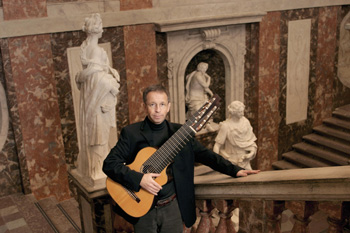
I'm truly captivated by Göran Söllscher's rendition of baroque pieces on this CD with his eleven string guitar. The music comes out perfectly natural and in the most musical way. Although he does take a little too much liberty with the rhythm, one is still feel the sincerity in his interpretation. The way he plays is never overpowering in terms of volume yet the music comes through to the listener with a powerful message, is extremely refined yet the expression of the music doesn't suffer. He just has this amazing gift of caressing such exquisite sounds out of his instrument. He truly has my utmost respect for his interpretation of baroque pieces.
Website
Subscribe to:
Posts (Atom)