I never quite believe in practising backwards in order to memorise the piece of music better. It's just detrimental to the musicality of the piece and I find that it's too high a price to pay in order to memorise the piece of music. And I'm really surprised that even professional musicians advocate this method in order to aid memory.
I can never find much sense in practising backwards. You can't grasp the flow of the music. One just start practising the last page or section of the music and more often than not, you start in the middle of a phrase and that is the worst feeling ever. What comes out eventually is nonsensical and meaningless. Even if you separate the piece in a way such that whatever section you play starts on the beginning of a phrase, it is still pretty much as bad because you can't shape the phrase well without knowing the introduction before it and how the phrase fits into the whole picture. Eventually, even if you manage to go through the whole piece, chances are that some sections will stick out like a sore thumb as the piece of music has lost its flow.
Anyways, I lost the connection to quite a number of recordings out there. They don't affect me as much as they used to. Maybe I'm becoming increasingly critical and having higher expectations. Yes, and that also means that I'm getting more nitpicky in the minor details of my music, not to mention that there's still this intonation problem I have. Oh well, practices have become quite a torture. How I wish that I have a better guitar to practise on...
Saturday, August 27, 2005

Saturday, August 20, 2005
Crossing Boundaries
The boundaries between classical music (maybe some people might be more comfortable with the term experimental music) and rock music have blurred, especially prominent in the previous few decades. And the thing is that they've both been previously perceived to be on opposite ends of the music spectrum. Maybe that's just part and parcel of this experimental age, where composers have seeked to search for inspirations in their art through other genres of music. Advant-garde composers have sought to study with masters of other genres of music like Indian classical music, gamelan music etc. And whatever modern movement sweeping through the classical scene, we can see it being caught on by the rock scene as well, with microtonality and minimalism as some examples.
I seem to have this feeling that people now are more obsessed with having radical ideas of creating music than in the resulting music that is produced. Heart-stirring melodies and harmonies, though not completely marginalised, have taken a backseat to coming up with the ideas itself. I agree that most of the music they make do satisfy the ear, but they just lack the ability to penetrate deep into the deeper chambers of our bodies...
Now, that's the kind of music that most talented composers of our time are composing. Is it indeed a pitiful wastage of their talent that half of the world is lamenting about, or is it just because the audiences are more narrow-minded than what art audiences ought to be?
I seem to have this feeling that people now are more obsessed with having radical ideas of creating music than in the resulting music that is produced. Heart-stirring melodies and harmonies, though not completely marginalised, have taken a backseat to coming up with the ideas itself. I agree that most of the music they make do satisfy the ear, but they just lack the ability to penetrate deep into the deeper chambers of our bodies...
Now, that's the kind of music that most talented composers of our time are composing. Is it indeed a pitiful wastage of their talent that half of the world is lamenting about, or is it just because the audiences are more narrow-minded than what art audiences ought to be?
Tuesday, August 09, 2005
Carnival of Music #10
Alright, it's my turn to host the Carnival of Music this week. A million thanks to Scott Spiegelberg for hosting a marvellous Carnival last week. Think I'll divide the posts into various genres so readers will find it easier to browse through their beloved topics.
Traditional Classical Music
In the news, we have some problem with iPods playing classical music. I swear this is one of the sickening problems whenever I listen to classical music on the bus and trains, especially symphonies and concertos where there're huge and sudden dynamics changes.
Oh, be sure to take a look at the professional violinist, Midori's blog on her concert tour in Asia. She sure has some interesting insights in this two-week blog.
Also, we have Talvi's experiences with the halls used for the Mostly Mozart Festival.
And not forgetting Greg Sandow's refutation of someone's keyntoe speech about classical music. He even mentioned some excellent ideas on how to attract younger audiences into the classical music scene, though I've some doubts that it'd be productive.
Modernism or Anti-Modernism
This week, Kyle Gann has given some lovely reviews on Aaron Copland's opera The Tender Land and Marc Blitzstein's opera Regina. Alright, the latter wasn't that lovely, from the way he wrote the review, but if his reviews certainly got me interested in getting recordings of such modern opera to listen.
Tim Rutherford-Johnson gave his comments on the a particular music of 1975 - Rzewski: The People United Will Never Be Defeated, in his series of Music since 1960. He sure took lots of effort in looking for 36 links to match the 36 variations in that piece by Rzewski. But I'm sure for lovers of modern music, it'll be worth the time and effort browsing through the list.
Now for anti-modernism, take a look at harpist Helen Radice's opinions on electronic music. Guess she's one of them who's anti-modernism but substantiates her stand very well.
Jazz
Arh, for this genre, Mwanji Ezana has been kind enough to compile a list of links to jazz blogs around the blogosphere. I'm thankful for the help as I know nuts about jazz.
Others
For this section, I'll have posts which consist of a mixture of the previous few genres above. Rob Witt's review of a musicircus book, The Time of Our Singing by Richard Powers, sure got my attention. That's going to one book I'll be looking out for when I visit the library or bookstore.
Would like to thank JohnL for letting me host the Carnival this week and Lynn S for volunteering to host the Carnival next week. Anyone who would like to volunteer to host the Carnival of Music in the next few weeks please feel free to email JohnL at music.carnival@gmail.com. =)
(This is a similar entry of the previous post on the Carnival of Music #10 in order to have the Carnival at the top of my blog for this week.)
Traditional Classical Music
In the news, we have some problem with iPods playing classical music. I swear this is one of the sickening problems whenever I listen to classical music on the bus and trains, especially symphonies and concertos where there're huge and sudden dynamics changes.
Oh, be sure to take a look at the professional violinist, Midori's blog on her concert tour in Asia. She sure has some interesting insights in this two-week blog.
Also, we have Talvi's experiences with the halls used for the Mostly Mozart Festival.
And not forgetting Greg Sandow's refutation of someone's keyntoe speech about classical music. He even mentioned some excellent ideas on how to attract younger audiences into the classical music scene, though I've some doubts that it'd be productive.
Modernism or Anti-Modernism
This week, Kyle Gann has given some lovely reviews on Aaron Copland's opera The Tender Land and Marc Blitzstein's opera Regina. Alright, the latter wasn't that lovely, from the way he wrote the review, but if his reviews certainly got me interested in getting recordings of such modern opera to listen.
Tim Rutherford-Johnson gave his comments on the a particular music of 1975 - Rzewski: The People United Will Never Be Defeated, in his series of Music since 1960. He sure took lots of effort in looking for 36 links to match the 36 variations in that piece by Rzewski. But I'm sure for lovers of modern music, it'll be worth the time and effort browsing through the list.
Now for anti-modernism, take a look at harpist Helen Radice's opinions on electronic music. Guess she's one of them who's anti-modernism but substantiates her stand very well.
Jazz
Arh, for this genre, Mwanji Ezana has been kind enough to compile a list of links to jazz blogs around the blogosphere. I'm thankful for the help as I know nuts about jazz.
Others
For this section, I'll have posts which consist of a mixture of the previous few genres above. Rob Witt's review of a musicircus book, The Time of Our Singing by Richard Powers, sure got my attention. That's going to one book I'll be looking out for when I visit the library or bookstore.
Would like to thank JohnL for letting me host the Carnival this week and Lynn S for volunteering to host the Carnival next week. Anyone who would like to volunteer to host the Carnival of Music in the next few weeks please feel free to email JohnL at music.carnival@gmail.com. =)
(This is a similar entry of the previous post on the Carnival of Music #10 in order to have the Carnival at the top of my blog for this week.)
Sunday, August 07, 2005
Carnival of Music #10
Alright, it's my turn to host the Carnival of Music this week. A million thanks to Scott Spiegelberg for hosting a marvellous Carnival last week. Think I'll divide the posts into various genres so readers will find it easier to browse through their beloved topics.
Traditional Classical Music
In the news, we have some problem with iPods playing classical music. I swear this is one of the sickening problems whenever I listen to classical music on the bus and trains, especially symphonies and concertos where there're huge and sudden dynamics changes.
Oh, be sure to take a look at the professional violinist, Midori's blog on her concert tour in Asia. She sure has some interesting insights in this two-week blog.
Also, we have Talvi's experiences with the halls used for the Mostly Mozart Festival.
And not forgetting Greg Sandow's refutation of someone's keyntoe speech about classical music. He even mentioned some excellent ideas on how to attract younger audiences into the classical music scene, though I've some doubts that it'd be productive.
Modernism or Anti-Modernism
This week, Kyle Gann has given some lovely reviews on Aaron Copland's opera The Tender Land and Marc Blitzstein's opera Regina. Alright, the latter wasn't that lovely, from the way he wrote the review, but if his reviews certainly got me interested in getting recordings of such modern opera to listen.
Tim Rutherford-Johnson gave his comments on the a particular music of 1975 - Rzewski: The People United Will Never Be Defeated, in his series of Music since 1960. He sure took lots of effort in looking for 36 links to match the 36 variations in that piece by Rzewski. But I'm sure for lovers of modern music, it'll be worth the time and effort browsing through the list.
Now for anti-modernism, take a look at harpist Helen Radice's opinions on electronic music. Guess she's one of them who's anti-modernism but substantiates her stand very well.
Jazz
Arh, for this genre, Mwanji Ezana has been kind enough to compile a list of links to jazz blogs around the blogosphere. I'm thankful for the help as I know nuts about jazz.
Others
For this section, I'll have posts which consist of a mixture of the previous few genres above. Rob Witt's review of a musicircus book, The Time of Our Singing by Richard Powers, sure got my attention. That's going to one book I'll be looking out for when I visit the library or bookstore.
Would like to thank JohnL for letting me host the Carnival this week and Lynn S for volunteering to host the Carnival next week. Anyone who would like to volunteer to host the Carnival of Music in the next few weeks please feel free to email JohnL at music.carnival@gmail.com. =)
Traditional Classical Music
In the news, we have some problem with iPods playing classical music. I swear this is one of the sickening problems whenever I listen to classical music on the bus and trains, especially symphonies and concertos where there're huge and sudden dynamics changes.
Oh, be sure to take a look at the professional violinist, Midori's blog on her concert tour in Asia. She sure has some interesting insights in this two-week blog.
Also, we have Talvi's experiences with the halls used for the Mostly Mozart Festival.
And not forgetting Greg Sandow's refutation of someone's keyntoe speech about classical music. He even mentioned some excellent ideas on how to attract younger audiences into the classical music scene, though I've some doubts that it'd be productive.
Modernism or Anti-Modernism
This week, Kyle Gann has given some lovely reviews on Aaron Copland's opera The Tender Land and Marc Blitzstein's opera Regina. Alright, the latter wasn't that lovely, from the way he wrote the review, but if his reviews certainly got me interested in getting recordings of such modern opera to listen.
Tim Rutherford-Johnson gave his comments on the a particular music of 1975 - Rzewski: The People United Will Never Be Defeated, in his series of Music since 1960. He sure took lots of effort in looking for 36 links to match the 36 variations in that piece by Rzewski. But I'm sure for lovers of modern music, it'll be worth the time and effort browsing through the list.
Now for anti-modernism, take a look at harpist Helen Radice's opinions on electronic music. Guess she's one of them who's anti-modernism but substantiates her stand very well.
Jazz
Arh, for this genre, Mwanji Ezana has been kind enough to compile a list of links to jazz blogs around the blogosphere. I'm thankful for the help as I know nuts about jazz.
Others
For this section, I'll have posts which consist of a mixture of the previous few genres above. Rob Witt's review of a musicircus book, The Time of Our Singing by Richard Powers, sure got my attention. That's going to one book I'll be looking out for when I visit the library or bookstore.
Would like to thank JohnL for letting me host the Carnival this week and Lynn S for volunteering to host the Carnival next week. Anyone who would like to volunteer to host the Carnival of Music in the next few weeks please feel free to email JohnL at music.carnival@gmail.com. =)
Saturday, August 06, 2005
Disgusted
Apparently, someone can't decide whether she wants to be a hooker or a professional violinist. Browsed through her website and there's quite a fair amount of vulgarities and unseemly language. Don't get me wrong, classical music isn't just for the high class people, but the way she portrays herself as a rowdy, punk kid is just so unacceptable of a professional classical violinist. Her CD covers makes me feel as if I'm browsing through some near-pornographic magazine out at the stands. Ok, even if her music is stunningly beautiful (which is far from it, unfortunately), I'll be embarrassed recommending it to friends, for they'll no doubt give me that incredulous look and contemplate whether I'm attracted to the music or CD cover. And I didn't like her interpretations of the tracks in her CDs one bit at all, and you can be sure that it wasn't due to my prejudice against her. I was treating the music as some professional recording, but I was terribly disappointed...
What irks me most is the fact that she has tainted the purity of the classical music scene. I seriously suggest that she should just consider changing profession, for I feel that the red light district suits her much better than a recording studio or concert hall...
What irks me most is the fact that she has tainted the purity of the classical music scene. I seriously suggest that she should just consider changing profession, for I feel that the red light district suits her much better than a recording studio or concert hall...
Friday, August 05, 2005
Musical Perceptions About the Carnival of Music
Be sure to take a look over at Scott Spiegelberg's blog, where he's hosting the Carnival of Music #9 this week. He sure had an interesting way of putting those musical posts together. That's gonna be the most special Carnival ever hosted ever since it started two months back and more importantly, there're quite a few interesting articles within the jillian number of links this week, so be sure not to miss them out. =)
I'll be hosting the Carnival next week, so if anyone has any posts on music to share, just send them to me at jeff_guitar@hotmail.com.
I'll be hosting the Carnival next week, so if anyone has any posts on music to share, just send them to me at jeff_guitar@hotmail.com.
Wednesday, August 03, 2005
Obsession With Modern Music
I find myself being addicted to books on modern music or composers than classical guitar books. I swear that if I had the money that day, I would have gotten the book on John Cage than the book on the life of Andrés Segovia.
John Cage's repetitive blasphemous comments almost made me tore that pages out. I'm sure if asked on how did he find Bach, Beethovan or Mozart, he'd have condemned them as well. He was one big egocentric person who called people who didn't understand his music idiots and shot down all comments that his music originated from God by repeatedly claiming that he was the sole creator of his music. I'm really interested in his perspective on the world of sounds and admire his innovative composition techniques. He's no doubt a genius, but he's such a 'staunch' atheist. And that pretty much make him a religious fool... Oh well...
John Cage's repetitive blasphemous comments almost made me tore that pages out. I'm sure if asked on how did he find Bach, Beethovan or Mozart, he'd have condemned them as well. He was one big egocentric person who called people who didn't understand his music idiots and shot down all comments that his music originated from God by repeatedly claiming that he was the sole creator of his music. I'm really interested in his perspective on the world of sounds and admire his innovative composition techniques. He's no doubt a genius, but he's such a 'staunch' atheist. And that pretty much make him a religious fool... Oh well...
Tuesday, August 02, 2005
Schubert's Arpeggione Sonata
Now for something more traditional instead of those tick-tock-bang-boom modern pieces. Have been listening to Franz Schubert's Arpeggione Sonata pretty often these few days. Parts of this profound and emotionally volatile piece sounds terribly anguished and exhibits such cyclothymic qualities while the other parts present the cheerful and lively side of his character, even sounding sugary sweet at times. And the magical side of this piece to me is the transitions between the dark and bright sides never sounded unnatural and it reflects how much emotional turmoil Schubert had gone through in the process of composing this magnificent piece of art.
It was written exactly two years after he contacted syphilis and the following excerpt is part of a letter Schubert had written to his friend Leopold Kupelweiser:
And I just know that I'm not going to let this most beautiful gem escape me and I shall master the transcription of piece for guitar and a string ensemble in the near future.
It was written exactly two years after he contacted syphilis and the following excerpt is part of a letter Schubert had written to his friend Leopold Kupelweiser:
In a word, I feel myself to be the most unhappy and wretched creature in the world. Imagine a man whose health will never be right again, and who in sheer despair over this ever makes things worse and worse, instead of better; imagine a man, I say, whose most brilliant hopes have come to nothing, to whom the joy of love and friendship have nothing to offer but pain, at best, whose enthusiasm (at least of the stimulating kind) for all things beautiful threatens to vanish, and ask yourself, is he not a miserable, unhappy being? — "My peace is gone, my heart is sore, I shall find it never and nevermore." I may well sing every day now, for each night, I go to bed hoping never to wake again, and each morning only tells me of yesterday's grief.
-Franz Schubert, Dokumente 1817-1830, i: Texte, ed. T. G. Waidelich (Tutzing, 1993) 234
And I just know that I'm not going to let this most beautiful gem escape me and I shall master the transcription of piece for guitar and a string ensemble in the near future.
Monday, August 01, 2005
Andrés Segovia - The Primitive Man
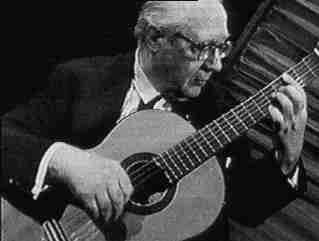
Andrés Segovia
I really wonder how would the present guitar scene be if Andrés Segovia, the father of the modern day guitar, had accepted Arnold Schoenberg's request to write for the guitar. He had previously found the guitar repertoire to be too limited and asked the composers of his day to write for the guitar, yet when Arnold Schoenberg and composers of atonal music came forward to offer to write for the guitar, he had rejected them straight in the face. I do respect him for the fact that he was the founder of the modern day guitar, otherwise the classical guitar will never make it up to the concert stage and John Williams will probably follow his father's footsteps and be a jazz guitarist. But I'm just a little piqued for his action of rejecting compositions by atonal composers and playing most compositions by Manuel Ponce in his later years. Ponce was another composer who was too primitive for his time. I have to admit that he was a prolific composer and I really love his music, but I thought that he would have been more famous if he had been borned a century earlier. Oh well...
Maybe I'm sinking too deeply into modern music. I could feel myself shaking a little when I realised the fact that Schoenberg had requested to write for the guitar and Segovia had slammed the door shut in his face. You could have imagined what nasty things I would have done to Segovia if I was able to go back in time. Atonal music may seem to have less emotional value than traditional tonal music, but I'm liking them for their experimental value. And I just felt it's time we ought to recognise atonal music as a development in the timeline of music instead of pretending that this style of composition had never been present all these while.
Friday, July 29, 2005
Minimalism
We've stepped half a decade into the twenty-first century and it seems that, unlike the visual arts, the classical music world still have a lot of trouble trying to understand music from the last century. In performances of modern works, the moods and meanings of the pieces eludes even the most seasoned of performers. If the performers themselves couldn't connect to their pieces emotionally, how do we expect them to communicate with the audiences what those music are about? Schoenberg was probably right when he commented that his "music is not really modern, just badly played".
Twentieth century music consists of several styles of music composition techniques - serialism, aleatoric music, impressionism, minimalism, jazz-influenced classical music (please correct me if there is a specific term for such music) etc. It seems that the most problematic styles which the classical music world have trouble appreciating are that former two, but I'll going to post some of my opinions on minimalist music for I've been listening to a few of such pieces recently.
For those who are unsure of what's minimal music, they're simply music stripped of all the its complexity and exploits the use of repetition. And don't worry about the excessive dissonance that is so characteristic of twentieth century pieces, for minimal music consist of mostly, if not entirely, tonal harmonies. I've not listened to the whole range of such music, but I'll recommend Arvo Pärt's Sarah Was Ninety Years Old, Philip Glass's Closing (Listen out for the subtle changing rhythms and tone colours), Terry Riley's In C. Such a minimalist movement is also pretty much alive in popular music - trance music.
Now we have the definition of minimal music, the problem comes. Do we consider such minimalism as modernism or anti-modernism? Considering just the contents of the music, it consists of the simplest musical material and that'll mean the minimalist movement is a big step back in time. But the main factor is such music isn't so much of the seemingly minimal content as its experimental attitude and thus composers of minimalist works still have to struggle all the same to bring their music into the concert stage and recordings.
Minimalist compositions may sound meaningless, for they project audible changes gradually over prolonged periods of time and thus induces a trance-like state in its listeners. Yes, not much of the traditional passionate emotions involved, but I personally feel that such works allow the ear to delve deep into the resonance of the individual sounds. And it really emphasises on the purity of the sound. Within the extended length of one simple interval, the tone, timbre and intensity can change, bringing about a rich assortment of harmonics. It's like a violin increasing its volume over the span of one note and intensifying the mood. And in minimal music, I've realised that the focus isn't on the music or harmony, it's on the sound. The rich sounds draw the listeners into the pure and fascinating world of sounds. And that's the very beauty of minimal music to me.
Alright, that's all from me today, though there's so much more about minimalism to be commented, like its history and the progression into postminimalism. I'll write more when I've acquired more knowledge into modern music.
Wednesday, July 27, 2005
The Carnival of Music
Arh, I've decided to help host the Carnival of Music two weeks later. A million thanks to JohnL for giving me this chance to host and this is a wonderful project for bringing all the posts on music in the blogging world together.
This week, we have The Llama Butchers hosting the Carnival of Music #8. Be sure to visit their site, for there're a few interesting posts on music for this week. =)
Maybe I ought to submit a post for next week's Carnival by Scott Spielberg at Musical Perceptions. Shall probably write on my opinions on twentieth century music, which I've been listening to more often recently. If I manage to rush out my post by Friday that is...
"The Carnival of Music is a celebration of all things musical - listening to or playing it, writing or recording it, analyzing or criticizing it. Music history, music theory, and composition are all welcome and encouraged in featured entries. I will not limit genres; classical, jazz, pop, rock, rap, country -- all are welcome here."
-JohnL
This week, we have The Llama Butchers hosting the Carnival of Music #8. Be sure to visit their site, for there're a few interesting posts on music for this week. =)
Maybe I ought to submit a post for next week's Carnival by Scott Spielberg at Musical Perceptions. Shall probably write on my opinions on twentieth century music, which I've been listening to more often recently. If I manage to rush out my post by Friday that is...
Sunday, July 24, 2005
Maestro Joaquin Rodrigo

Late Maestro Rodrigo and wife, Victoria
I just got the DVD Shadows & Light on the late spanish composer Joaquin Rodrigo. It starts with Pepe Romero playing his most famous guitar concerto, Concierto de Aranjuez, and followed by all his smaller works played by renowned artists who are good friends with this wonderful composer. This is one moving story which touches me in a very special way whenever I listen to that concerto. And I'm incredible touched by the deep love Joaquin Rodrigo and his wife have for each other. The perfect romance...
For those who haven't heard this concerto before, I'd strongly recommend Pepe Romero's 2nd recording of it. Flawless and incredible moving, taking into account of the fact that Pepe has known Maestro Rodrigo since young. The only downside is that he does his vibrato like he's having a spasm. Well, shall write more of this wonderful concerto in the near future.
"Joaquín Rodrigo at 90 is an intimate and intensely personal exploration of the world-renowned Spanish composer. He has created some of the most beautiful music ever written. His Concierto de Aranjuez is as famous as Cervantes’ Don Quixote and the paintings of Goya. At 90, he is a man whose youthful exuberance and extrovert personality have yielded to the introversion and silent meditation of old age. ‘Shadows and Light’ portrays a man who has found inspiration in his belief in God but has also suffered greatly at the hand of his own demons. He is a man who has been blind since early childhood, but has never allowed his disability to inhibit his artistic vision. He is a man who is sustained by the love and support of his family, and who has always upheld the most basic values. His story is truly inspirational, as it has been to everyone who was involved in the making of this film.”
-Director Larry Weinstein, writing in 1993, said of his 60 minute film ‘Shadows and Light’
Food for Thought
"When you play music, if you truly surrender your ego and your self, you lose the awareness of your own body, and your body becomes the body of the sound. You perceive your own person as being inside the tone, inside the sound, and of course the audience is also inside the tone, so you are really one, and it's really difficult for me to know where I end and the public begins, I feel a real togetherness and a real oneness, bonded by the tone, by the actual physical vibration of the sound. And this is a wonderful experience."Alright, he did seem a little incoherent cause his native language is Spanish, but the meaning is there. I just didn't quite agree with the audience portion. When I think about the audience when playing music, it really takes out more than half of my attention from the music and I eventually can't connect with my music as well as in my practices. Maybe only seasoned performers are capable of being completely at ease when playing in front of huge audiences...
-Pepe Romero, renowned classical guitarist
Thursday, July 21, 2005
Interesting Comment
"the English do carol; the French sing, the Spaniards weep, the Italians... caper with their voices; the others bark, but the Germans (which I am ashamed to utter) do howl like wolves..."Now, that was written by this German writer in 1609. That sounds a little harsh on his fellow countrymen and I guess they really pissed him off pretty badly to make him come up with such a comment...
-German writer who took the Greek name Ornithoparchus
If this German singer...
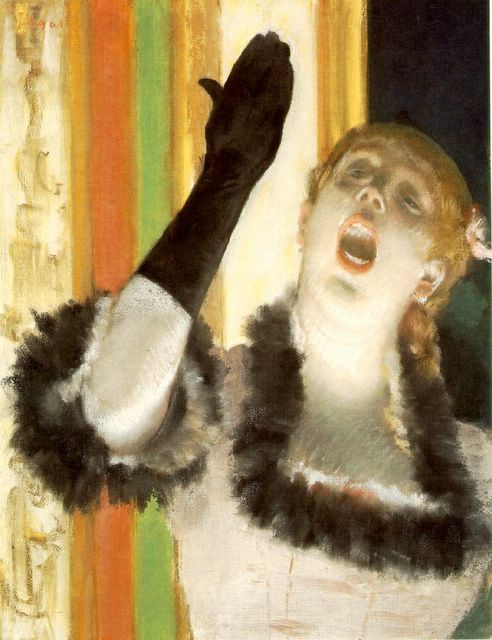
howls like a wolf...

then how do you describe this...

Wednesday, July 20, 2005
Should It Sound Divine or Danceable?
Should my Bach's Fugue from BWV 1000 sound divine or danceable? Have been listening to major artistes from the two general schools playing Bach, with legendary artistes like Henryk Szeryng, Arthur Grumiaux etc in the school which craft Bach's pieces in a divine way and in the other school, there'll be those who play Bach in a lighter, danceable style.
I've never been very supportive of the latter school, especially when they twist and desecrate the works until the very essence of Bach's music is lost. It wasn't until I heard of Hilary Hahn's rendition of Bach that changed my mind. Or rather, she's an exception. She completely tore down the divine nature of the works and recreate a completely different yet amazing effect that is not at all inferior to the former camp. Her recordings of the 3 sonata and partitas captured my total attention the first time I heard them. It's taxing to listen to the Chaconne by Szeryng twice consecutively yet for Hahn, I can just go on and on without feeling any decrease in the intensity and passion. But well, what I could accept from the latter camp can only stop there. I can't accept how artistes like Lara St John and Yo-Yo Ma (his second recording of Bach) butcher up Bach and left his pieces unbearable for the ears.
Of course, now considering the fact that I play the guitar, it'd probably take a miracle on top of an impeccable technique and astounding musicality to make Bach's pieces sound divine. Well, maybe I ought to focus more on making it danceable, yet at the same time not take too much liberty with the tempo...
I've never been very supportive of the latter school, especially when they twist and desecrate the works until the very essence of Bach's music is lost. It wasn't until I heard of Hilary Hahn's rendition of Bach that changed my mind. Or rather, she's an exception. She completely tore down the divine nature of the works and recreate a completely different yet amazing effect that is not at all inferior to the former camp. Her recordings of the 3 sonata and partitas captured my total attention the first time I heard them. It's taxing to listen to the Chaconne by Szeryng twice consecutively yet for Hahn, I can just go on and on without feeling any decrease in the intensity and passion. But well, what I could accept from the latter camp can only stop there. I can't accept how artistes like Lara St John and Yo-Yo Ma (his second recording of Bach) butcher up Bach and left his pieces unbearable for the ears.
Of course, now considering the fact that I play the guitar, it'd probably take a miracle on top of an impeccable technique and astounding musicality to make Bach's pieces sound divine. Well, maybe I ought to focus more on making it danceable, yet at the same time not take too much liberty with the tempo...
Subscribe to:
Posts (Atom)